The elements of pathological histology with special reference to practical methods / by Anton Weichselbaum ; tr. by W.R. Dawson.
- Weichselbaum, A. (Anton), 1845-1920.
- Date:
- 1895
Licence: Public Domain Mark
Credit: The elements of pathological histology with special reference to practical methods / by Anton Weichselbaum ; tr. by W.R. Dawson. Source: Wellcome Collection.
Provider: This material has been provided by the Francis A. Countway Library of Medicine, through the Medical Heritage Library. The original may be consulted at the Francis A. Countway Library of Medicine, Harvard Medical School.
19/530
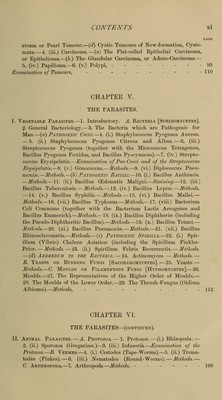
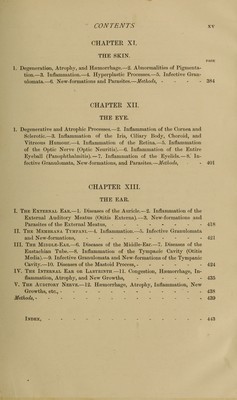
![PAGE atoma or Pearl Tumour.—{d) Cystic Tumours of New-formation, Cysto- mata.—4. (iii.) Carcinoma.—{a) The Flat-celled Epithelial Carcinoma, or Epithelioma.—{b.) The Glandular Carcinoma, or Adeno-Carcinoma.— 5. (iv.) Papilloma.—6. (v.) Polypi, 95 Examination of Tumours, - - -110 CHAPTER V. THE PAEASITES. I. Vegetable Parasites.—1. Introductory. A. Bacteria [Schizomycetes]. ^. General Bacteriology.—3. The Bacteria which are Pathogenic for Man.—(a) Pathogenic Cocci.—4. (i.) Staphylococcus Pyogenes Aureus. — 5. (ii.) Staphylococcus Pyogenes Citreus and Albus. — 6. (iii.) Streptococcus Pyogenes (together with the Micrococcus Tetragenus, Bacillus Pyogenes Foetidus, and Bacillus Pyocyaneus).—7. (iv.) Strepto- coccus Erysipelatis.—Examination of Pus-Cocci and of the Streptococcus Erysipelatis.—8. (v.) Gonococcus.—Methods.—9. (vi.) Diplococcus Pneu- moniae.—Methods.—(6) Pathogenic Bacilli.—10. (i.) Bacillus Anthracis. —Methods.—11. (ii.) Bacillus CEdematis Maligni.—Staining.—12. (iii.) Bacillus Tuberculosis. — J/ci'Aoo^s. —13. (iv.) Bacillus Leprae.—Methods. —14. (v.) Bacillus Syphilis.—Methods. —15. (vi.) Bacillus Mallei.— Methods.—16. (vii.) Bacillus Typhosus.—Methods.—17. (viii.) Bacterium Coli Commune (together with the Bacterium Lactis Aerogenes and Bacillus Emmerich).—Methods.— IB. (ix.) Bacillus Diphtheriae (including the Pseudo-Dii^htheritic Bacillus).—Methods.—19. (x.) Bacillus Tetani.— Methods.—20. (xi.) Bacillus Pneumoniae.—Methods.—21. (xii.) Bacillus Rhinoscleromatis.—Methods.—(c) Pathogenic Spirilla.—22. (i.) Spir- illum (Vibrio) Cholerae Asiaticae (including the Spirillum Finkler- Prior. — Methods. — 23. (ii.) Spirillum Febris Pecurrentis.—Methods. —{d) Addendum to the Bacteria. — 24. Actinomyces. — Methods. — B. Yeasts or Budding Fungi [Saccharomycetes]. — 25. Yeasts — Methods.—G. Moulds or Filamentous Fungi [Hyphomycetes].—26. Moulds.—27. The Eepresentatives of the Higher Order of Moulds.— 28. The Moulds of the Lower Order.—29. The Thrush-Fungus (Oidium Albicans).—Methods, - - - - - ■ - - - - 112 CHAPTER VI. THE PARASITES—(continued). II. Animal Parasites. — A. Protozoa. — 1. Protozoa.—(i.) Rhizopoda.— 2. (ii.) Sporozoa (Gregarinae.)—3. (iii.) Infusoria.—Examinatio7i of the Protozoa.—B. Vermes.—4. (i.) Cestodes (Tape-Worms).—5. (ii.) Trema- todes (Flukes). — 6. (iii.) Nematodes (Round-Worm.s). — Methods.— C. Arthropoda.—7. Arthropods.—Methods, - 166](https://iiif.wellcomecollection.org/image/b21083708_0019.jp2/full/800%2C/0/default.jpg)
 No text description is available for this image
 No text description is available for this image
 No text description is available for this image