The elements of pathological histology with special reference to practical methods / by Anton Weichselbaum ; tr. by W.R. Dawson.
- Weichselbaum, A. (Anton), 1845-1920.
- Date:
- 1895
Licence: Public Domain Mark
Credit: The elements of pathological histology with special reference to practical methods / by Anton Weichselbaum ; tr. by W.R. Dawson. Source: Wellcome Collection.
Provider: This material has been provided by the Francis A. Countway Library of Medicine, through the Medical Heritage Library. The original may be consulted at the Francis A. Countway Library of Medicine, Harvard Medical School.
42/530 page 16
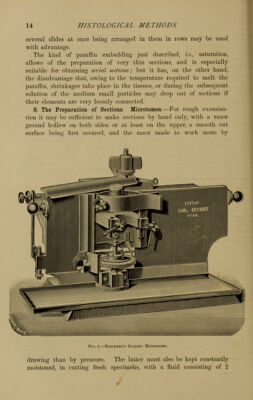
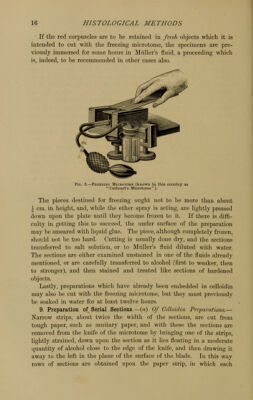
![If the red corpuscles are to be retained in fresh objects which it is intended to cut with the freezing microtome, the specimens are pre- viously immersed for some hours in Muller's fluid, a proceeding which is, indeed, to be recommended in other cases also. Fig. 3.—Freezing Microtome [known in this country as Cathcart's Microtome]. The pieces destined for freezing ought not to be more than about \ cm. in height, and, while the ether spray is acting, are lightly pressed down upon the plate until they become frozen to it. If there is diffi- culty in getting this to succeed, the under surface of the preparation may be smeared with liquid glue. The piece, although completely frozen, should not be too hard. Cutting is usually done dry, and the sections transferred to salt solution, or to Miiller's fluid diluted with water. The sections are either examined unstained in one of the fluids already mentioned, or are carefully transferred to alcohol (first to weaker, then to stronger), and then stained and treated like sections of hardened objects. Lastly, preparations which have already been embedded in celloidin may also be cut with the freezing microtome, but they must previously be soaked in water for at least twelve hours. 9. Preparation of Serial Sections.—(«) Of Celloidin Preparations.— Narrow strips, about twice the width of the sections, are cut from tough paper, such as sanitary paper, and with these the sections are removed from the knife of the microtome by bringing one of the strips, lightly strained, down upon the section as it lies floating in a moderate quantity of alcohol close to the edge of the knife, and then drawing it away to the left in the plane of the surface of the blade. In this way rows of sections are obtained upon the paper strip, in which each](https://iiif.wellcomecollection.org/image/b21083708_0042.jp2/full/800%2C/0/default.jpg)
 No text description is available for this image
 No text description is available for this image
 No text description is available for this image