Treatise on natural philosophy : Vol 1. Part 2 / by Sir William Thomson and Peter Guthrie Tait.
- Date:
- 1883
Licence: Public Domain Mark
Credit: Treatise on natural philosophy : Vol 1. Part 2 / by Sir William Thomson and Peter Guthrie Tait. Source: Wellcome Collection.
Provider: This material has been provided by the Royal College of Physicians of Edinburgh. The original may be consulted at the Royal College of Physicians of Edinburgh.
492/594 page 462
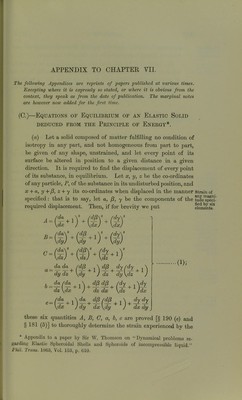
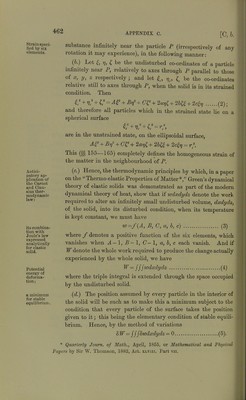
![APPENDIX C. Strain speci- fied by six elements. Antici- patory ap- plication of the Carnot and Clau- sius ther- modynamic law: its combina- tion with Joule’s law expressed analytically for elastic solid. Potential energy of deforma- tion; a minimum for stable equilibrium. [C, b. substance infinitely near the particle P (irrespectively of any rotation it may experience), in the following manner: (b.) Let £, rj, £ be the undisturbed co-ordinates of a particle infinitely near P, relatively to axes through P parallel to those of x, y, z respectively ; and let V/, £ be the co-ordinates relative still to axes through P, when the solid is in its strained condition. Then £/2 + v/ + C = A£2 + Byf + CC 4- 2ar]C + 2b£g + 2c£r) (2); and therefore all particles which in the strained state lie on a spherical surface are in the unstrained state, on the ellipsoidal surface, Ae + Byf + Ctf + 2arii + 2bH + 2c^ = rf. This (§§ 155—165) completely defines the homogeneous strain of the matter in the neighbourhood of P. (c.) Hence, the thermodynamic principles by which, in a paper on the “Thermo-elastic Properties of Matter*,” Green’s dynamical theory of elastic solids was demonstrated as part of the modern dynamical theory of heat, show that if wdxdydz denote the work required to alter an infinitely small undisturbed volume, dxdydz, of the solid, into its disturbed condition, when its temperature is kept constant, we must have w=f(A, B, C, a, b, c) (3) where f denotes a positive function of the six elements, which vanishes when A-\, B-l, (7-1, a, b, c each vanish. And if W denote the -whole work required to produce the change actually experienced by the whole solid, we have W = fff wdxdydz (4) where the triple integral is extended through the space occupied by the undisturbed solid. (d.) The position assumed by every particle in the interior of the solid will be such as to make this a minimum subject to the condition that every particle of the surface takes the position given to it; this being the elementary condition of stable equili- brium. Hence, by the method of variations SJF = fff&wdxdydz = 0 (5). * Quarterly Journ. of Math., April, 1855, or Mathematical and Physical Papers by Sir W. Thomson, 1882, Art, xlviii. Part vii.](https://iiif.wellcomecollection.org/image/b21987312_0492.jp2/full/800%2C/0/default.jpg)