Treatise on natural philosophy : Vol 1. Part 2 / by Sir William Thomson and Peter Guthrie Tait.
- Date:
- 1883
Licence: Public Domain Mark
Credit: Treatise on natural philosophy : Vol 1. Part 2 / by Sir William Thomson and Peter Guthrie Tait. Source: Wellcome Collection.
Provider: This material has been provided by the Royal College of Physicians of Edinburgh. The original may be consulted at the Royal College of Physicians of Edinburgh.
539/594 page 509
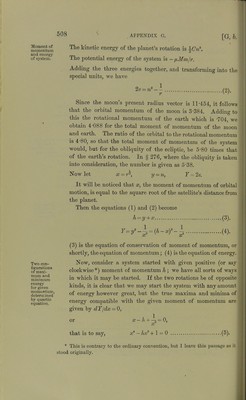
![G, 6.] TIDAL FRICTION. 500 I We shall presently see that this quartic has either two real roots and two imaginary, or all imaginary roots*. This quartic may be derived from quite a different con- sideration, viz., by finding the condition under which the satellite may move round the planet, so that the planet shall always show the same face to the satellite, in fact, so that they move as parts of one rigid body. The condition is simply that the satellite’s orbital angular velocity O = n the planet’s angular velocity of rotation; or since n-y and r'~ = = x, therefore y = 1 /a?3. By substituting this value of y in the equation of momentum (3), we get as before x*-hx8 + 1=0 (5). In my paper on the “Precession of a Viscous Spheroidf,” I obtained the quartic equation from this last point of view only, and considered analytically and numerically its bearings on the history of the earth. Sir William Thomson, having read the paper, told me that he thought that much light might be thrown on the general physical meaning of the equation, by a comparison of the equation of conservation of moment of momentum with the energy of the system for various configurations, and he suggested the appro- priateness of geometrical illustration for the purpose of this comparison. The method which is worked out below is the result of the suggestions given me by him in conversation. The simplicity with which complicated mechanical interactions may be thus traced out geometrically to their results appears truly remarkable. At present we have only obtained one result, viz.: that if with given moment of momentum it is possible to set the satellite and planet moving as a rigid body, then it is possible to do so in two ways, and one of these ways requires a maximum amount of energy and the other a minimum; from which it is clear that one must be a rapid rotation with the satellite near the planet, and the other a slow one with the satellite remote from the planet. * I have elsewhere shown that when it has real roots, one is greater and the other less than £ h. Proc. Roy. Soe. No. 202, 1880. t Trans. Roy. Soc. Part i. 1879. In these configura- tions the satellite moves as though rigidly connected with the planet.](https://iiif.wellcomecollection.org/image/b21987312_0539.jp2/full/800%2C/0/default.jpg)