Chronological history of plants : man's record of his own existence illustrated through their names, uses, and companionship / by Charles Pickering.
- Charles Pickering
- Date:
- 1879
Licence: Public Domain Mark
Credit: Chronological history of plants : man's record of his own existence illustrated through their names, uses, and companionship / by Charles Pickering. Source: Wellcome Collection.
72/1252 page 48
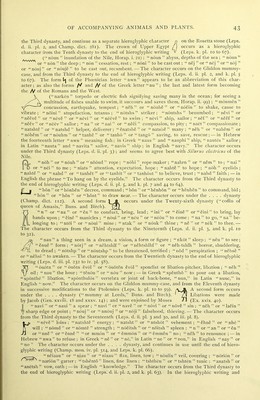
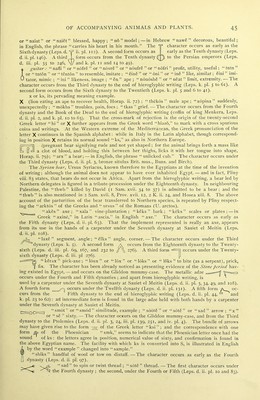
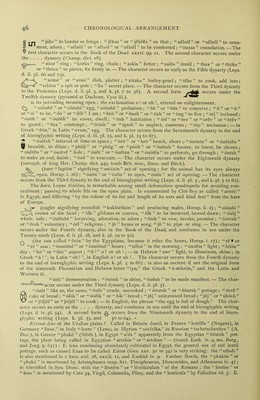
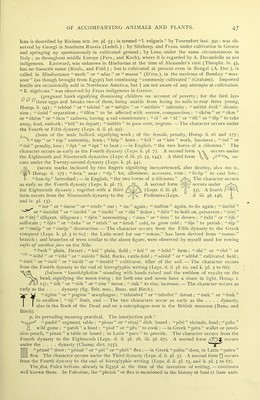
![J4) ; in Greece, the “psullos ” is mentioned by Aristophanes nub. 145 and 831, Dioscorides, and Lu- cian; and in Italy, the “ pulex ” by Columella, Pliny, and Martial. Eastward from Asia, the flea was found by myself aboriginally introduced throughout the inhabited islands of the Pacific ; was also aboriginally introduced throughout America to the shores of the Atlantic in New England (R. Wil- liams key, 6), having in the last two instances evidently accompanied the dog. ■ “ paganos ” head-quarters, or palace ; “ tshtop ” inn ; “ pretsh ” or“pors” mat; “portsh” or “ pbrtsh ” or “ prtsh ” to spread out, strew ; — in English “preach,” and “ porch.” The charac- ter occurs on the Gliddon mummy-case. A second form |pj occurs under the Third and Fourth dynasties (Leps. d. ii. pi. 3 and 27, Champ, mon iv. 325, JM 326). “pat” knee; “ p6ht ” or “paht” to fall down before, prostrate one’s self; “p£ht” to bow jSy down; “aspS” or “aspi” or “sapi” tongue, speech; “saps” or “s£ps” or “sops” or “s£ps6p” or “sopsp” or “sopsfip ” to beseech, supplicate. -—The character occurs under the .... dynasty (Champ, gram. 343, and Rosellin. mon. cul. 38). “pdonS” or “p66nS” or “ pbbni ” or “p££n§” migration, to remove; “pet” or “p6t” or “phbt” or “phet” to run, flee; “ s£pe ” swiftness ; “polsh ” or “ pdlsh ” to be delivered from, liberated.—The character occurs under the Seventeenth dynasty (Leps d. iii. pi. 5), is perhaps the origin of the form *1 of the seventeenth Phoenician letter “ pha,” and of the earliest form P of the Greek letter “pi.” The Nubia.71 throwing-club is besides figured under the Twelfth dynasty at Beni- hassan (Champ, mon. pi. 395) ; was found by Bonomi ninev. iv. 1 and pi. 41 employed by the Bishareen as a missile principally for capturing game ; the pattern, as observed by myself, continuing unchanged. Acacia Nilotica of the Southern border of the Sahara as far as Arabia. Called in Yemen “ soul ” or “ saelam,” in Egypt “ sant ” (Forsk.) or as heard by myself “sbnt”; in which we recognize its original Egyptian name “sond” or “tshond ” : the Nubian throwing-clubs according to my Dongola attendant are made of “selem” wood, and were ascertained by Bonomi to be of “sunt” ; the river- barges in use at the time of the invention of writing may also have been of this timber, — as in the time of Herodotus ii. 96, and to the present day (Clot-Bey ii. 2. 29) : the tree with its marked foliage is figured at Benihassan under the Twelfth dynasty (Champ, d. ii. pi. 18) ; the “ akakia ” of Egypt is described by Dioscorides as yielding a black “ stuptiken ” astringent gum, mentioned also by Pliny xxiv. 65, Rhazes, and the mode of procuring it described by Abdallatif i. 2 : A. Nilotica, whose pods are besides used for tanning (Clot-Bey), was observed by myself planted and naturalized around vil- lages throughout Egypt to the end of my journey at Assouan; beyond, according to Lepsius eg. and sin. p. 129 to 170, is distinguished by the Nubians as “the tree,” and was observed by him indigenous in Upper Nubia. Eastward, was observed by Forskal indigenous along the base of the mountains of Yemen, the bark used for tanning; by myself, under cultivation only at Muscat; is called in Sanscrit “burbura,” in Bengalee “ babula ” or “ babool,” in Telinga “ nella-tooma ” (Lindl.), and the “ babool ” tree, planted through the suggestion of Gibson, has become “common in the Deccan ” (Graham), principally as observed by myself for its shade along roadsides. A hieroglyphic character f] (possibly representing the rib) agrees at least in shape with the Mesopoiamian throwing-club. also under the Third, and down — The character is painted red on the Gliddon mummy-case, occurs to the Seventeenth dynasty (Leps. d. ii. pi. 3, and iii. pi. 5). A throwing-club of similar shape is held by an Egyptian under the Seventeenth dynasty, by the Asiatic strangers at Benihassan under the Twelfth dynasty (Leps. d. iii. pi. 9, and ii. pi. 131), and by individ- uals on the Assyrian monuments. ^ “ pbms ” scurrility ; “ pashsS ” or “ patsS ” spittle. — The character occurs in the Book of the • Dead, also under the .... dynasty (Champ, gram. 99, 42, 154, and Buns, and Birch). (ichneumon signifying weakness, succoured by others; for the animal calls others to its assistance before resisting a serpent, Horap. ii. 31) ; “ pakSn-het ” pusillanimous ; “ pSnhet ” poor, destitute ;—in Greek “pSnes” poor; in Latin “penuria,” penury, “pauper.” The character occurs in the Ritual, also under the .... dynasty (Buns, and Birch). The ichneumon, although belonging to a Tropical genus is known to inhabit Egypt along the Nile;-—was in ancient times protected bylaw, is at present called “ nems,” and although very de- structive to all smaller animals is sometimes domesticated (Clot-Bey ii. 66). As inhabiting Egypt is mentioned by Aelian, Pliny, Lucan, and other Greek and Roman writers. mantis or praying-insect; “pStd” (one of the insects enumerated in transl. Levit. xi. 22) ; “pStd” corslet; “pStd-tot Svol ” fishmonger. — The character occurs under the .... dynasty (Champ, diet. 168). stand of balance-scales; “pesh”to be at variance; “p61j” or “ pbrj ” dissension ; “patshS” half; “shijapi” to be in suspense, waver;—in English “to halt between two opinions.” The character occurs as early as the Fourth dynasty (Leps. d. ii. pi. 2). A second form occurs from the Seventh dynasty to the Eighteenth (Leps. k. pi. 6 to 27). And a third from the Eighteenth dynasty to the Twentieth (Leps. k. pi. 28 to 41).](https://iiif.wellcomecollection.org/image/b24887122_0076.jp2/full/800%2C/0/default.jpg)