Chronological history of plants : man's record of his own existence illustrated through their names, uses, and companionship / by Charles Pickering.
- Charles Pickering
- Date:
- 1879
Licence: Public Domain Mark
Credit: Chronological history of plants : man's record of his own existence illustrated through their names, uses, and companionship / by Charles Pickering. Source: Wellcome Collection.
74/1252 page 50
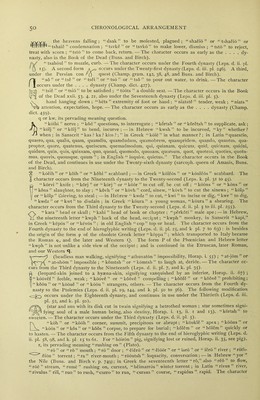
![YY yY- *-he f>eavens falling; “ dsak ” to be molested, plagued; “ shabio ” or “ tshabio ” or H “ tshaiS ” condemnation ; “ tsvkb ” or “ tsvko ” to make lower, dismiss; “ tsto ” to reject, treat with scorn; “tst5 ” to come back, return. — The character occurs as early as the .... dy- nasty, also in the Book of the Dead (Buns, and Birch). “ tsahdul ” to muzzle, curb. — The character occurs under the Fourth dynasty (Leps. d. ii. pi. 15). A second form occurs under the Twenty-first dynasty (Leps. d. iii. pi. 246). A third, under the Persian con rQ quest (Champ, gram. 142, 38, 48, and Buns, and Birch). “ sd ” or “ tsS ” or “ tsbi ”■ or “ tsd ” or “ ts6 ” to pour out water, to drink. — The character I X occurs under the .... dynasty (Champ, diet. 427). “ tsiS ” or “ tsid ” to be satisfied ; “ todts ” a double seat. — The character occurs in the Book of the Dead xxii. 53. 4. 21, also under the Seventeenth dynasty (Leps. d. iii. pi. 5). hand hanging down; “ hets ” extremity of foot or hand; “ niatstb ” tender, weak ; “ niats ” attention, expectation, hope. — The character occurs as early as the .... dynasty (Champ, diet. 459). q or kw, its pervading meaning question. Jk “ koihi ” nerve ; “ kdd ” questions, to interrogate ; “ kdrtsh ” or “ kbrbtsh ” to supplicate, ask ; /T\ “kolj” or “kdlj” to bend, incurve; — in Hebrew “ kwsh ” to be incurved, “ ky ” whether? when ; in Sanscrit “ kas ? ka ? kim ?; ” in Greek “ koie ” in what manner ?; in Latin “ quaestio, quaero, qua, qualis, quam, quamdiu, quamdudum, quamobrem, quampridem, quando, quantus, qua- propter, quare, quatenus, queiscum, quemadmodum, qui, quianam, quicum, quid, quidnam, quidni, quidum, quin, quis, quisnam, quo, quoad, quomodo, quonam, quorsum, quot, quoteni, quoties, quotu- mus, quovis, quousque, quum ” ; in English “ inquire, quietus.” The character occurs in the Book of the Dead, and continues in use under the Twenty-sixth dynasty (sarcoph. queen of Amasis, Buns, and Birch). f? “ koSih ” or “ k6ih ” or “ kbhi ” scabbard ; — in Greek “ kolbbs ” or “ koulSos ” scabbard. The K character occurs from the Nineteenth dynasty to the Twenty-second (Leps. k. pi. 31 to 45). “ kbrvi ” knife ; “ kbrj ” or “ k5rj ” or “ k5or ” to cut off, be cut off ; “ kdons ” or “ kons ” or : kbns ” slaughter, to slay ; “ kdvh ” or “ kovh ” cord, sinew, “ kovh ” to cut the sinews ; “ kolp ” or “ k61p ” thieving, to steal ; — in Hebrew “ kwdz ” to cut, “ kwi ” to incise or dig, “ kwr ” to dig, kwdz ” or “ kwt ” to disdain ; in Greek “ koura ” a young woman, “ koura ” a shearing. The character occurs from the Third dynasty to the Twenty-second (Leps. d. ii. pi. 5 to iii. pi. 255). S~\ “ kara ” head or skull; “ kahi ” head of book or chapter; “pbrkbti” male ape;—in Hebrew, Li the nineteenth letter “kwph ” back of the head, occiput; “kwph” monkey, in Sanscrit “kapi,” in Greek “ kepos ” or “kevos ” ; in old English “cop” top or head. The character occurs from the Fourth dynasty to the end of hieroglyphic writing (Leps. d. ii. pi. 25, and k pi. 7 to 63) : is besides the origin of the form 9 of the obsolete Greek letter “koppa” ; which transported to Italy became the Roman q, and the later and Western O. The form P of the Phoenician and Hebrew letter “ kwph ” is not unlike a side view of the occiput; and is continued in the Etruscan, later Roman, and our Western C], W (headless man walking, signifying “ athunaton ” impossibility, Horap. i. 55) ; “at-jom ” or “ at-shom ” impossible ; “ kbmtsh ” or “ komtsh ” to laugh at, deride. — The character oc- curs from the Third dynasty to the Nineteenth (Leps. d. ii. pi. 7, and k. pi. 35). S (leopard-skin joined to a hyaena-skin, signifying vanquished by an inferior, Horap. ii. 67) ; “ ko5v£f ” feeble, weak ; “ koovb ” or “ kbbvS ” compelling ; “ k66f£ ” or “ k66v£ ” prohibiting ; “ kbou ” or “ koou8 ” or “ koou ” strangers, others. — The character occurs from the Fourth dy- nasty to the Ptolemies (Leps. d. ii. pi. 19, 144, and k. pi. 50 to 56). The following modification <3^3 occurs under the Eighteenth dynasty, and continues in use under the Thirtieth (Leps. d. iii. pi. 52, and k. pi. 50). (star and sun with its disk cut in twain signifying a betrothed woman ; star sometimes signi- /y<^' fying soul of a male human being, also destiny, Horap. i. 13, ii. 1 and 13). “kbrtsh” to sweeten. — The character occurs under the Third dynasty (Leps. d. ii. pi. 5). r\ “k5h” or “ kooh ” corner, summit, precipitous or abrupt; “kouklS” apex; “k5ons”or I v “koos” or “kbs” or “ k66s ” corpse, to prepare for burial; “ l<61£m ” or “ h616m ” quickly or to hasten. — The character occurs from the Fifth dynasty to the end of hieroglyphic writing (Leps. d. ii. pi. 58, 98, and k. pi. 15 to 61. For “ hoirdn ” pig, signifying lost or ruined, Horap. ii. 35, see pig), r, its pervading meaning “rushing on” (Plato). ‘roth- ; yor “ ro ” or “ r6 ” mouth ; “ ro ” door ; “ bibro ” or “ bibor ” or “ iar5 ” or “ ibro ” river ; bion ” torrent; “ra” river-mouth; “ rooutsh ” loquacity, conversation;—in Hebrew the Nile (Buns, and Birch v. p. 749); in Greek the seventeenth letter “ r6,” also “red” to flow, “ roe ” stream, “ rume ” rushing on, current, “ hbimarros ” winter torrent; in Latin “ rivus ” river, “ rivulus ” rill, “ ruo ” to rush, “ curro ” to run, “ cursus ” course, “ rapidus ” rapid. The character](https://iiif.wellcomecollection.org/image/b24887122_0078.jp2/full/800%2C/0/default.jpg)