An inquiry into the variations of the human skull, particularly in the antero-posterior direction / by John Cleland ; communicated by Allen Thomson.
- Cleland, John, 1835-1924.
- Date:
- 1870
Licence: Public Domain Mark
Credit: An inquiry into the variations of the human skull, particularly in the antero-posterior direction / by John Cleland ; communicated by Allen Thomson. Source: Wellcome Collection.
Provider: This material has been provided by The University of Glasgow Library. The original may be consulted at The University of Glasgow Library.
20/90 (page 128)
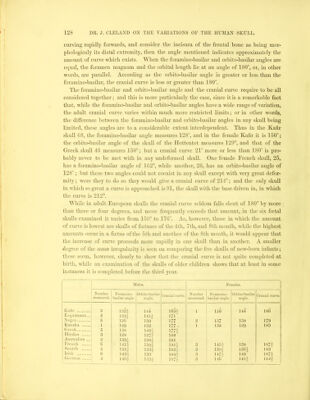
![cun ing rapidly forwards, and consider the incisura of the frontal bone as being mor- phologicaly its distal extremity, then the angle mentioned indicates approximately the amount of curve which exists. When the forammo-basilar and orbito-basilar angles are equal, the foramen magnum and the orbital length lie at an angle of 180°, or, in other words, are parallel. According as the orbito-basilar angle is greater or less than the foramino-basilar, the cranial curve is less or greater than 180°. The foramino-basilar and orbito-basilar angle and the cranial curve require to be all considered together; and this is more particularly the case, since it is a remarkable fact that, while the foramino-basilar and orbito-basilar angles have a wide range of variation, the adult cranial curve varies within much more restricted limits; or in other words, the difference between the foramino-basilar and orbito-basilar angles in any skull being limited, these angles are to a considerable extent interdependent. Thus in the Kafir skull 08, the foramino-basilar angle measures 128°, and in the female Kafir it is 150°; the orbito-basilar angle of the skull of the Hottentot measures 129°, and that of the Greek skull 40 measures 150°; but a cranial curve 21° more or less than 180° is pro- bably never to be met with in any undeformed skull. One female French skull, 25, has a foramino-basilar angle of 102°, while another, 20, has an orbito-basilar angle of 128°; but these two angles could not coexist in any skull except with very great defor- mity; were they to do so they would give a cranial curve of 214°; and the only skull in which so great a curve is approached is 91, the skull with tlie base driven in, in which the curve is 212°. While in adult European skulls the cranial curve seldom falls short of 180° by more than three or four degi'ees, and more frequently exceeds that amount, in the six foetal skulls examined it varies from 150° to 170°. As, however, those in which the amount of curve is lowest are skulls of foetuses of the 4th, 7th, and 8th month, while the highest amounts occur in a foetus of the 5th and another of the 8th month, it would appear that the increase of curve proceeds more rapidly in one skull than in another. A smaller degree of the same irregularity is seen on comparing the five skulls of new-born infants; these seem, however, clearly to show that the cranial curve is not quite completed at birth, while an examination of the skulls of older children shows that at least in some instances it is completed before the third year. Males. Females. ' Xuraber ' measured. Foramino- basilar angle. Orbito-basilar angle. 1 Cranial curre. Number measured. Foramino- basilar angle. Orbito-basilar angle. Cranial curve. Kafir 3 133’- I4I 169| 1 150 I4I 186 Esquimaux... o 132.1 1 41.1 171 ^]eg'•o 5 136' 139' 177 2 137 138 179 Kanaka 1 129 132 177 . 1 1.38 129 189 Greek 5 138 140^ 177i Hindoo 3 128 1274 180 Australian o 1391 1381 181 French Scotch 6 . 5 14U 135| 139| 133f 181# 1824 3 2 145a 1.39-f 138 136.V 187f 183' Irish 6 143a 1.39 184i 3 I47I 140 1874 German .5 146i I39I- 1874- 3 146' 141# 1843-](https://iiif.wellcomecollection.org/image/b24918817_0020.jp2/full/800%2C/0/default.jpg)