Volume 1
Glen's law of public health and local government / [William Cunningham Glen].
- W. Cunningham Glen
- Date:
- 1925
Licence: Public Domain Mark
Credit: Glen's law of public health and local government / [William Cunningham Glen]. Source: Wellcome Collection.
1463/1480 (page 1193)
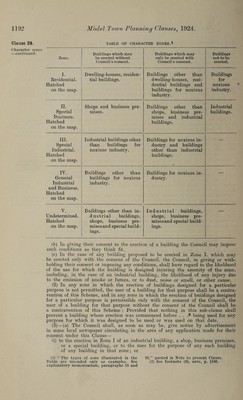
![(ii) to the erection in Zone III of any building other than an industrial building, or to the user of any building in that zone for any purpose other than the purpose of an industrial building. The notice shall be at the cost of the applicant and shall state that any objec¬ tions addressed to the Council in writing within 14 days after the date of the advertisement will be considered. (b) The Council shall take into consideration any objections received within the said period of 14 days, and shall thereupon decide to give or withhold their consent or to give their consent upon such conditions as they think fit, and shall forthwith serve a notice of their decision upon the applicant and upon any person objecting to the application under paragraph (a) of this sub-clause. (c) A decision of the Council under this Clause shall not take effect until the expiration of 21 days from the date on which the applicant and the objectors, if any, are notified of the decision, or, if an appeal has been made to the Minister under the provisions of this Clause, until such appeal is disposed of. (4)—(a) Any person who has applied for any consent of the Council under this Clause and feels aggrieved by any neglect or refusal of the Council to give consent or by any conditions imposed by the Council may [apply to the Minister for leave to appeal to him 3], (b) Any person wTho feels aggrieved by any decision of the Council to give consent to the erection of, or user of a building as, an industrial building, a shop, business premises or a special building in Zone I or to the erection of any building other than an industrial building in Zone III or to the user of any building in that zone for any purpose other than the purpose of an industrial building may [apply to the Minister for leave to appeal to him,3] and shall forthwith notify the Council of the [application3]. Note. Par. 25 of the Memorandum is headed “ Method of Imposing Restrictions, and is as follows :—“ The actual restrictions in each zone are to be indicated by means of a Table, but the Table inserted in the Model Clause is intended only as an example of the form in which the zoning provisions should be set out, and not as necessarily indicating the types of zone always to be adopted, or as suggest¬ ing that every area should include all the indicated zones. The definitions employed have been framed to cover as many classes of buildings as seem likely to require to be differentiated for the purpose of determining the uses of zones, and all undefined buildings are classed as ‘ special buildings,’ so that, by specifying them where necessary in the Table, the local authority may be able to govern their introduction into any zone and so minimise the risk of injury through the erection of any class of buildings which may not have been foreseen. Experience will no doubt reveal other classes of buildings which ought to be defined, and the object should always be to limit the class of ‘ special buildings to the narrowest possible scope. The schedule of ‘ buildings for noxious industry ’ is intended to cover industrial buildings such as works under the Alkali Works Regulation Act, 1906, which require to be specially placed, whether in an industrial area or not. Par. 26 is headed “ Types of Zone,” and is as follows : ‘‘In drafting the illustrations given in the Table, regard has been had to the consideration that it wall generally be unwise, except in the case of small zones devoted to specialised purposes, to exclude entirely any class of buildings (except such a class as ‘ noxious industries ’). Thus in Zone I, which may be applicable to large areas, uses other than the predominant use may be admitted with the consent of the authority, but where these uses are at variance with the predominant use they are only to be admitted after advertisement in the manner indicated in paragraph 23.4 Zone IV, an example of a general industrial and business zone, is left practically unrestricted, so as to admit any buildings whose owners are prepared to dispense with protection against possible injury from incongruous forms of development. It is contem¬ plated that small specialised zones will be adopted only in the case of peculiarly suitable areas in wrhich development of the kind provided for can be confident \ anticipated. The last illustration is of a zone intended to be applied to areas of the kind already referred to in paragraph 24,5 in wThich there is no prospect ot early development and the natural trend of development cannot at the moment be foreseen.” (3) See footnote (3), post, p. 1199 D. (4) Namely, “ in order to give any adjoin¬ ing owners or other interested persons who might object to the proposals an opportunity of appealing.” (5) Namely, “ areas not likely to be developed for a considerable period.” Clause 28. Character zones —continued. Zoning.](https://iiif.wellcomecollection.org/image/b31361687_0001_1463.jp2/full/800%2C/0/default.jpg)