The care of the baby : a manual for mothers and nurses, containing practical directions for the management of infancy and childhood in health and in disease / by J. P. Crozer Griffith.
- John Price Crozer Griffith
- Date:
- 1903
Licence: Public Domain Mark
Credit: The care of the baby : a manual for mothers and nurses, containing practical directions for the management of infancy and childhood in health and in disease / by J. P. Crozer Griffith. Source: Wellcome Collection.
Provider: This material has been provided by the Augustus C. Long Health Sciences Library at Columbia University and Columbia University Libraries/Information Services, through the Medical Heritage Library. The original may be consulted at the the Augustus C. Long Health Sciences Library at Columbia University and Columbia University.
36/462 (page 36)
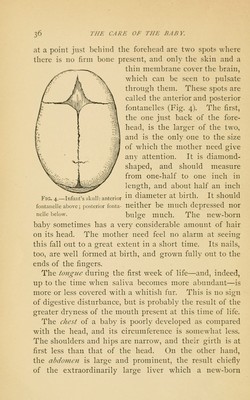
![at a point just ])chind the forehead are two spots where there is no firm bone present, and only the skin and a thin membrane cover the brain, which can be seen to pulsate through them. These spots are called the anterior and posterior fontanelles (Fig. 4). The first, the one just back of the fore- head, is the larger of the two, and is the only one to the size of which the mother need give any attention. It is diamond- shaped, and should measure from one-half to one inch in length, and about half an inch Fig. 4.-infant'sskull:anterior ^ diameter at birth. It should fontaneiie above; posterior fonta- neither be mucli depressed nor neiie below. bulge mucli. The new-born baby sometimes has a very considerable amount of hair on its head. The mother need feel no alarm at seeing this fall out to a great extent in a short time. Its nails, too, are well formed at birth, and grown fully out to the ends of the fingers. The tongue during the first week of life—and, indeed, up to the time when saliva becomes more abundant—is more or less covered with a whitish fur. This is no sign of digestive disturbance, but is probably the result of the greater dryness of the mouth present at this time of life. The chest of a baby is poorly developed as compared with the head, and its circumference is somewhat less. The shoulders and hips are narrow, and their girth is at first less than that of the head. On the other hand, the abdomen is large and prominent, the result chiefly of the extraordinarily large liver which a new-born](https://iiif.wellcomecollection.org/image/b2122058x_0036.jp2/full/800%2C/0/default.jpg)