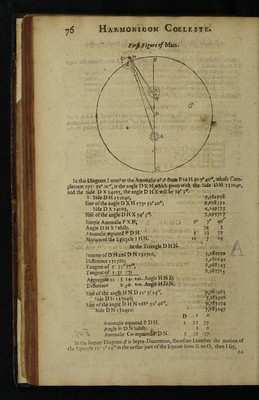
Harmonicon coeleste: or, the coelestiall harmony of the visible world / conteining, an absolute and entire piece of astronomie. Wherein is succinctly handled the trigonometricall part, generally propounded, and particularly applyed in all questions tending to the diurnall motion. Especially respecting, and truly subservient to the main doctrine of the second motions of the luminaries and the other planets : together with their affections as eclipses &c. Grounded upon the most rationall hypothesis yet constituted, and compared with the best observations that are extant, especially those of Tycho Brahe, and other more modern observators ... By Vincent Wing, philomathemat.
- Vincent Wing
- Date:
- 1651
Licence: Public Domain Mark
Credit: Harmonicon coeleste: or, the coelestiall harmony of the visible world / conteining, an absolute and entire piece of astronomie. Wherein is succinctly handled the trigonometricall part, generally propounded, and particularly applyed in all questions tending to the diurnall motion. Especially respecting, and truly subservient to the main doctrine of the second motions of the luminaries and the other planets : together with their affections as eclipses &c. Grounded upon the most rationall hypothesis yet constituted, and compared with the best observations that are extant, especially those of Tycho Brahe, and other more modern observators ... By Vincent Wing, philomathemat. Source: Wellcome Collection.
105/350 (page 73)
![. s D / // 9 25 8 40 Ip 9 25 8 21 - 6 15 18 23 .8 20 10 2 H ARMONICON CoELESTE. 75 / * To finde the Rcdudion, I fay. As the Radius 9o\ \ 10,000000 To the Sine of the greatelf Redudion of U 30; 6,162696 So the double of the Argument ofindinat. 39*^ 28' 28, 9,80327 J To the Redudion of % requu^ed 19: 5^9^597^ And becaufe U is departing from his South Node, and approaching towards the Limits of his greateft Latitude, therefore (according to the former Rule) the Re¬ dudion is to be fubftraded from his place foundJn the Orbite. r True motion of % from O in his Orbite. Redudion Subftrad. True motion of U from G in the Ecliptiquc. True motion of 0 from the Earth. Anomalie of Commutation. To finde the Inclination of V. In the Redangle Sphsericall Triangle X K L (viz,, of the fecond Figure of V) is given,(i) theHypothenufeK 119*^44'14^'(2) theSideEB 12424 (viz,, under- ftood by the angle L K X.) Therefore I fay. As the Radius KE9o^ 10,000000 Jo the greateft Inclination EB 12424; • - , . .4,094261 So the Sine of K L 19^ 44A14/',, ,. V , , ^,528540 To the Inclination of XL 4196: 3,622801 But whereas A X is to be put for the Radius, the Inclination X L will be but 41 ap,' for as the common Radius of Orbite J22000, is to the Radius A L 513556, fo is the Inclination 4195, to the Inclination required X L 412p. Now having found his Inclination, and his diftance from the 0 in his Orbite, the faid Diftance is to be correfted by Curmtion. - In the third Figure following. 517785- 5,714149- 509527 - 5,707167. Aggregate 11,421316. Diftance of ^curtated 513639 J Semiag. 5,710658. ] Second Figure of Jupiter. Hypothenufe AL5i3656?5 Summc Inclination L X« 4^ ^9 $ Of i-’-L !](https://iiif.wellcomecollection.org/image/b30323411_0105.jp2/full/800%2C/0/default.jpg)