The treasury of natural history, or, A popular dictionary of zoology / by Samuel Maunder.
- Maunder, Samuel, 1785-1849.
- Date:
- 1870
Licence: Public Domain Mark
Credit: The treasury of natural history, or, A popular dictionary of zoology / by Samuel Maunder. Source: Wellcome Collection.
764/856 (page 742)
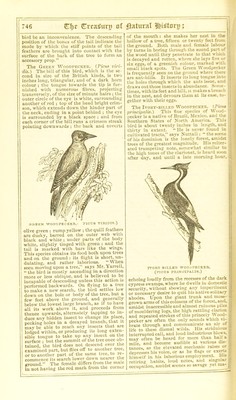
![they seem then to want that vivacity for I of the necessity of using net* with email which they are distinguished in the morning meshe s. It is now, however, a well-etta- and evening twilight. They are rarely shot blLhcd fuct, that no fry of valuab.e fitnea at or molested ; and from being thus trun- swim along with them ; and those who are sicntly seen in the obscurity of dunk, or in * 1 ~ tlie deep umbrage of the woods, no wonder their particular markings of plumage should be so little known, or that they should be confounded with the night hawk, whom in general appearance they so much resemble. The female begins to lay about the second week in May, selecting for this purpose the most unfrequented part of the wood, often where some brush, old logs, heaps of leaves, &c. had been lying, and always on a dry situation. The eggs are deposited on the ground, or on the leaves, not the slightest appearance of a nest being visible. These are usually two in number, in shape mueh resembling those of the night hawk, but having the ground colour much darker, and more thickly marbled with dark olive. “ Early in June, as soon as the young ap- pear, the notes of the male usually cease, or ore heard but rarely. Towards the latter part of summer, a short time before these birds leave us, they are again occasionally heard ; but their call is then not so loud, much less emphatical, and more interrupted than in spring. Early in September they move otf towards the south. “ The Whip-poor-will is nine inches and a half long, and nineteen inches in extent; the bill is blackish, a full quarter of an inch long, much strouger than that of the night hawk, and bent a little at the point, the under mandible arched a little upwards, fol- lowing the curvature of the upper ; the nostrils are prominent and tubular, their openings directed forward ; the mouth is extravagantly large, of a pale flesh-colour within, and beset along the sides with a number of long, thick, elastic bristles, the longest of which extends more than half an inch beyond the point of the bill, end in fine hair, and curve inwards ; these seem to serve as feelers, and prevent the escape of winged insects : the eyes are very large, full, and bluish black ; the plumage above is so varie- gated with black, pale cream, brown, and rust-colour, sprinkled and powdered in such minute streaks and spots, as to defy descrip- tion.” WHITE ADMIRAL [BUTTERFLY]. A name given by collectors to Butterflies of the genus Limenitis. WHITE ANT. [See Termes.] WHITEBAIT. (Clupea alba.) This small fish, which of late years has gained a sort of tavern celebrity as a dish suited to the epi- curism of certain “ diners-out,” appears in the Thames about the beginning of April, and becomes abundant during the summer months till September. It grows to the length of six inches, and its sides arc uni- formly of a white colour, whence its name. For a long time it was denied to be a distinct species, and supposed to be the fry of other members of the Herring tribe, and there are legislative enactments (now rarely if ever en- forced) against Whitebait fishing, on account prone to indulge in the luxury of a White- bait dinner on the banks of Father Thames need be under no apprehension of having gratified an epicurean tn*te at the expen*e of piscatorial impropriety. WHITE BORDER [BUTTERFLY]. A name given by collectors to a specie* of But- terfly, Vanessa Antiopa. WHITE [BUTTERFLIES]. A name applied by collectors to specie*of Butterflies, 1 of the genera Pieris, Puntia, and Leucopfuuia. WHITE SHARK. [See Shark.] WHITING. (Meilangvs vulgaris.) A well-known fish belonging to the Gadtdce or cod tribe, and valuable on account of it* delicacy and lightness as an article of food. It does not usually exceed a pound and a half in weight; abounds on all the British WH1TIKO.-fl!BM.ASOD8 VULGARIS.) coasts, and comes in large shoals toward* the shore in the months of January and February, for the purpose of depositing it* spawn. It is easily distinguished from the haddock by the absence of the barbule on the chin ; andfrom the pollack and coal-fish by having the under jaw shorter than the upper, aud the tail even at the end. WIDGEON. (Anas [Jfareca] Penelope.) A species of migratory hi rds,hred in the morasses of the north, which they quit on the approach of winter, and os they advance towards the end of their southern journey, they spread themselves along the shores, and over the marshes and lakes in various parts of the Contiucnt, as well as those of the British Isles. Here they remain during the winter, at the end of which the old birds pair : and the whole tribe, in full plumage, take their departure northward about the end of March. They commonly fly, in small flocks, during the night, and may be known from their congeners by tlieir whistling note while they are on the wing. They are easily domes- ticated in places where there is plenty of water, and are much admired for their beauty and sprightliness. The bill is an inch and a half long, narrow, and serrated on the inner edges, the upper mandible being of a dark lead colour, tipped with black. The crown of the head, which is very high and narrow, is of a cream colour, with a small spot of the same under each eye : the rest of the head, the neck, and the breast, are bright rufous chestnut, obscurely freckled on the head with black s|>ots, and darkest on the chin and throat, which are tinged with a](https://iiif.wellcomecollection.org/image/b24864201_0764.jp2/full/800%2C/0/default.jpg)