The treasury of natural history, or, A popular dictionary of zoology / by Samuel Maunder.
- Maunder, Samuel, 1785-1849.
- Date:
- 1870
Licence: Public Domain Mark
Credit: The treasury of natural history, or, A popular dictionary of zoology / by Samuel Maunder. Source: Wellcome Collection.
765/856 (page 743)
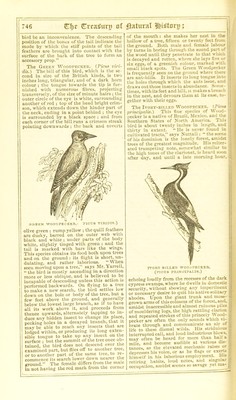
![£1 popular SBirttmiar. • vinous colour : a hand of waved or indented • narrow ash brown und white lines separates : the brea>t and neck : the hack and scapulars * are marked with similar feathers, as are also * the sides of the body under the wings i the belly, to the vent, is white : the great wing- coverts are brown, edged with white and : tipped with black, which forms an upper border to the changeable green beauty-spot of the wings, which is also bordered on the under side by another stripe formed by the WIDGEON. — V.MARECA PENELOPE.) deep velvet black tips of the secondary quills : the exterior webs of the adjoining quills are white, and those uext the back are of a deep brown, edged with yellowish white : the vent and upper tail-coverts are black. The tail . is ot a brownish ash colour, edged with yel- lowish white : the two middle feathers being • sharp-pointed, darker and longer than the rest. The legs and tots are of a dull lead colour, faintly tinged with green : the middle of the webs und nails black. The female is of a sober brown ; the fore part of the neck and breast paler ; scapulars dark brown, edges paler ; wings and belly as in the male The young of both sexes are gray, and con- . tinue so till February, when the plumage of the male begins gradually to assume its • rich colourings ; but after July the feathers become dark and gray, so that he is hardly • to be distinguished from his mate. WIDOW-BIRD. [See Whidah-fincu.] ID LOW \\ REN. (Sylvia trochUus.) ■ For a most pleasing description of this “ fairy bird,'’ we turn to Mr. W. C. Ilewitson’s elegant * Illustrations,’ &c. : and, with his consent, we copy the greater part of it. “ Much as I love all the dear birds of sum- mer,” says this gentleman, “there is not one the return of which I have yearly witnessed with so much pleasure os that of the Willow Wren ; and however more highly the rich melody of some of the other warblers may be prized, there is a simplicity and a sweet cadence about the note of this species, which never fails to excite within ine feelings of pleasure, which none but the lover of nature can either appreciate or understand, but which are to him amongst the chief enjoy- ments of his life. The Willow Wren is one 1 of the most abundant of the warblers, und i almost every wood and copse is enlivened by its beautiful form and graceful motions. : It is, too, an inhabitant of more northern countries ; and I shall not readily forget the delight I experienced on hearing its soft ■ sweet note, whilst seated within the Arctic of Stmniiitctf JJaturr. 743 Circle, upon one of the bleak isles of Nor- way. “ The Willow Wren builds its nest upon the ground, sometimes in the midst of woods, when not thick, but more commonly near the.r rnargin.or in open places, or hy the side of those grassy drives which are cut through them. It may be found in most of those grassy banks where brushwood occurs. In shape the nest resembles that of the common wren, being arched over, and entered from the side •, it is, however, much more fragile, und not easily moved entire ; it is composed of dry grass and moss, with dead leuves, warmly lined with feathers. . . . Mr. Neville Wood, in his British Song Birds, quotes a letter from Dr. Liverpool, describing the readiness with which the Willow Wren be- comes sociable. To this I can add a most interesting instance. To ascertain beyond doubt the identity of the two varieties of the eggs figured, I had captured, on their nests, several of the birds. Amongst these was one which I had curried home and confined during the night in a large box, and such was its tameness, that when I took it out the following morning, and would have set it at liberty, it seemed to have no wish to leave my hand, and would hop about the table at which I was sitting, picking up flies which I caught for it. In the autumn, pre- vious to their departure, the Willow Wrens frequent our gardens and orchards, where they may be seen busily picking insects from the pea-straw, and other vegetables, the young ones easily distinguished by their brighter yellow colouring ; sometimes wur- bling a farewell song, but in a tone fur differ- ent to their joyous carol in the spring, and so subdued that it is scarcely audible.” We are also indebted to the kindness of Mr. A. Hepburn, of Whittingham, for the following interesting notes on the Wil- low Wkkn. This plainly coloured but elegantly shaped species is a summer visi- tant in Britain, arriving in April und de- parting in September, and is abundantly dis- tributed over the whole wooded parts of the country. The male announces his presence by a simple song, composed of a few notes, on a descending scale, but the tone is so silvery that it seems to tell of all the swreet influences of spring, the April shower and sunshine, the bursting hud and the opening flower ; and what eye for the beautiful can fail to mark the elegance of Ills form as he nimbly glides amongst the young leaves, springs into the air uftcr an insect, or flits from tree to tree ? By and hy, when mated, a snug arched nest is built on the ground, in a tuft of grass or amongst other rank vegetation, and six or seven little white eggs spotted with red are deposited : the young are fed on a variety of caterpillars und insects, by the destruction of which, great benefit is conferred on the labours of the husbandman and gardener. There are often two broods in the season. WINDHOVER. [See Kestrel.] WOLF. (Canis Lupus.) A ferocious quadruped belonging to the Digitigrude Car- nivora. in habits und physical development closely related to the Dog. The Common](https://iiif.wellcomecollection.org/image/b24864201_0765.jp2/full/800%2C/0/default.jpg)