The treasury of natural history, or, A popular dictionary of zoology / by Samuel Maunder.
- Maunder, Samuel, 1785-1849.
- Date:
- 1870
Licence: Public Domain Mark
Credit: The treasury of natural history, or, A popular dictionary of zoology / by Samuel Maunder. Source: Wellcome Collection.
766/856 (page 744)
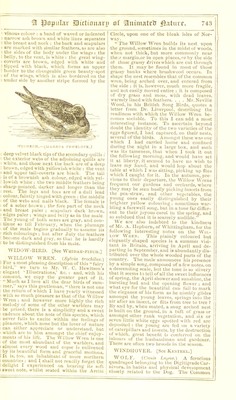
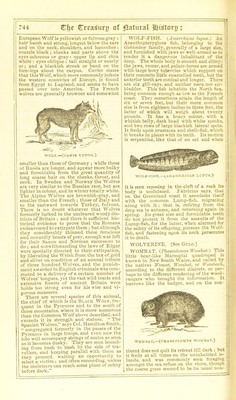
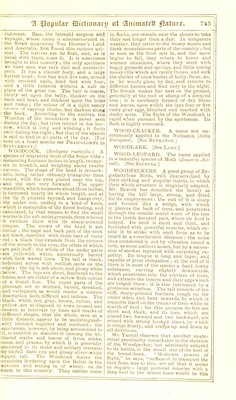
![European Wolf is yellowish or fulvous gray : hair harsh and strong, longest below the ears and on the neck, shoulders, and haunches: muzzle black ; cheeks and parts above the eyes oehreous or gray: upper lip and chin white : eyes oblique : tail straight or nearly so; and a blackish streak or band on the fore-legs about the carpus. Cuvier states that this Wolf, which more commonly infests the western countries of Europe, is found from Egypt to Lapland, and seems to have passed over into America. The French wolves are generally browner and somewhat <r£sT- ^ WOLF. —(CANI8 LUPUS.) smaller than those of Germany 5 while those of Russia are longer, and appear more bulky and formidable from the great quantity of long coarse hair on the cheeks, throat, and neck. In Sweden and Norway the Wolves are very similar to the Russian race, but are lighter in colour, and in winter totally white. The Alpine Wolves are brownish-grav, and smaller than the French ; those of Italy and to the eastward towards Turkey, fulvous. There is no doubt whatever that Wolves formerly lurked in the uncleared woody dis- tricts of Britain ; and there is sufficient his- torical evidence to prove that the Romans endeavoured to extirpate them ; but although they considerably thinned these ferocious and cowardly beasts of prey, enough was left for their Suxon and Norman successors to do ; and notwithstanding the laws of Edgar were specially directed to their extirpation, by liberating the Welsh from the tax of gold and silver on condition of an annual tribute of three hundred Wolves, and the punish- ment awarded to English criminals was com- muted to a delivery of a certain number of Wolves’ tongues, yet the vast wild tracts and extensive forests of ancient Britain were holds too strong even for his wise and vi- gorous measures. There are several species of this animal, the chief of which is the Black Wolf, fre- quent in the Pyrenees and to the south of those mountains, where it is more numerous than the Common Wolf above described, and exceeds it in strength and stature. “ The Spanish Wolves,” says Col. Hamilton Smith, “congregated formerly in the passes of the Pyrenees in large troops, and even now the lobo will accompany strings of mules as soon as it becomes dusky. They are seen bound- ing from bush to bush by the side of tra- vellers, and keeping parallel with them as they proceed, waiting an opportunity to select a victim ; and often succeeding, unless the muleteers can reach some place of safety before dark.” WOLF-FISH. (Anarrhictu luj/ut.) An Acanthopterygiouj fish, belonging to the GMovIe/je family, generally of a large size, and furnished with jaws so well-armed as to render it a dangerous inhabitant of the deep. The whole body is smooth and slimy: the jaws, vomer, and palate-bones are armed with large bony tubercles which support on their summits little enamelled teeth, but the anterior teeth are conical and longer. There are six gill-rays, and neither caeca nor air- bladder. This fish inhabits the North Sea, being common enough as low as the French coast. They sometimes attain the length of six or seven feet, but their more common size is from eighteen inches to three feet, the latter of which will weigh about twenty pounds. It has a hoarv colour, with a whitish belly, dark head with white e peck a, and two rows of large blackish lateral spots. It feeds upon Crustacea and shell-fish, which it breaks in pieces with its teeth. Its motion is serpentine, like that of an eel and when JJARRHJCA8 LGFUS.N it is seen reposing in the cleft of a rock its body is undulated. Fabricius says, that on the Greenland coast it associates itself with the common Lump-fish, migrating along with it ; that is. retiring from the deep sea in autumn, and returning again in spring. Its great size and formidable teeth do not protect it from the assaults of the Lump-fish, for the latter, when alarmed for the safety of its offspring, pursues the Wolf- fish, and’ fastening upon its neck persecutes it to death. WOLVERINE. [SeeGrLO.] WOMBAT. (PhascoJomm Wombat) This little bear-like Marsupial quadruped is known in New South Wales, and called by the natives Womat Wombat, or H ombach, according to the different dialect*, or per- haps to the different rendering of the wood- rangers who brought the information. It burrows like the badger, and on the con- WOMBAT,—(PHA8COLOMTS WOMBAT.) tinent does not quit its retreat till dark : but I it feeds nt nil times on the uninhabited is- | lands, and was commonly seen foraging amongst the sea refuse on the shore, though [ the coarse grass seemed to be its usual nou-](https://iiif.wellcomecollection.org/image/b24864201_0766.jp2/full/800%2C/0/default.jpg)