The treasury of natural history, or, A popular dictionary of zoology / by Samuel Maunder.
- Maunder, Samuel, 1785-1849.
- Date:
- 1870
Licence: Public Domain Mark
Credit: The treasury of natural history, or, A popular dictionary of zoology / by Samuel Maunder. Source: Wellcome Collection.
770/856 (page 748)
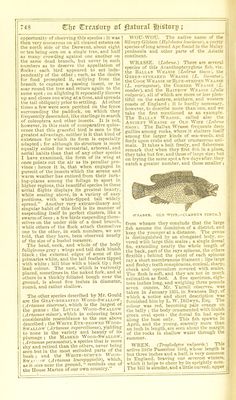
![opportunity of observing this species : it was then very numerous on all cleared estates on the north side of the Derwent, about eight or ten being seen on a single tree, and half as many crowding against one another on the same dead branch, but never in such numbers as to deserve the appellation of flocks: each bird appeared to act inde- pendently of the other ; each, as the desire for food prompted it, sallying from the branch to capture a passing insect, or to soar round the tree and return again to the same spot; on alighting it repeatedly throws up and closes one wing at a time, and spreads the tail obliquely prior to settling. At other times a few were seen perched on the fence surrounding the paddock, on which the}’ frequently descended, like starlings in search of coleoptera and other insects. It is not, however, in this state of comparative quies- cence that this graceful bird is seen to the greatest advantage, neither is it that kind of existence for which its form is especially adapted ; for although its structure is more equally suited for terrestrial, arboreal, and aerial habits than that of any other species I have examined, the form of its wing at once points out the air as its peculiar pro- vince : hence it is, that when engaged in pursuit of the insects which the serene and warm weather has enticed from their lurk- ing-places among the foliage to sport in higher regions, this beautiful species in these aerial flights displays its greatest beauty, while soaring above, in a variety of easy positions, with white-tipped tail widely spread.” Another very extraordinary and singular habit of this bird is its manner ot suspending itself in perfect clusters, like a swarm of bees ; a few birds suspending them- selves on the under side of a dead branch, while others of the flock attach themselves one to the other, in such numbers, we are told, that they have, been observed nearly of the size of a bushel measure. The head, neck, and whole of the body fuliginous gray ; wings and tail dark bluish black ; the external edges of some of the primaries white, and the tail feathers tipped with white ; bill blue with a black tip ; feet lead colour. The nest, which is variously placed, sometimes in the naked fork, and at others in a thickly foliated bough near the grouud, is about ttve inches in diameter, round, and rather shallow. The other species described by Mr. Gould are the Gray-breasted Wood-Swallow, (Artemius cinereus), which is the largest of the genus : the Little Wood-Swallow CArtamus minor), which in colouring bears considerable resemblance to the one above described ; the White Eye-browed Wood- Swallow (Artamus superciliosus), yielding to none in the variety and beauty of its plumage ; the Masked Wood-Swallow, (Artamus personatus), a species that is more shy and retired than the others, never being seen but in the most secluded parts of the bush ; and the White-humped Woon- Swa'’ >'V (Artamus leucopyffialh), which, as it uies near the ground, reminds one of the Ilouse Marten of our own country. WOU-WOU. The native name of the I Silvery Gibbon (JfyhJ/rite•» lmr\*nut). a pretty ] species of long armed Ape found in the Malay I>eninsula and other parte of the Asiatic continent. WRASSE. (JydmM.) There are several species of this Acanthopterygiou# fish. viz. | the Ballax Wrasse (Istl/rut tinea . the J| Green-streaked Wrasse (L. lifeniiu,. the Cook Wrasse or Blue-striked Wrasse (L. varitgalus), the Comber W comber), and the Rainbow Wp.as-e (Julii | vulgaris), all of which are more or \tt* plen- | tiful on the eastern, southern, and w< • coasts of England; it is hardly necessary. ! however, to describe more than one. and we | take the first mentioned as an example. The Ballax Wrasse, called also the I Ancient Wrasse or Old Wife <Labnu >j tinea). The Ball an Wrasse frequents deep ! gullies among rocks, where it shelters itself j among the larger kinds of sea-weedf. and j| feeds upon crabs and other crustaceons ani- mals. It takes a bait freely, and fishermen remark that when they first firh in a place, they take but few. and those of large size: but on trying the same 6pot a few days after, they ■ J catch a greater number, and those smaller ; WRASSE. OLD WIFE.—(LABBUS TINCA.) from whence they conclude that the large fish assume the dominion of a district, and , keep the younger at a distance. The genus j is distinguished by an elongated body, co- j vered with large thin scales ; a single dorsal ; fin, extending nearly the whole length of j the back, part of the rays spinous, the others flexible ; behind the point of each spinous j ray a short membranous filament; lips large i and fleshy; teeth conspicuous, conical, sharp; , cheek and operculum covered with scales, i The flesh is soft, and they are not in much : estimation as food. A fine specimen, eigh- j teen inches long, and weighing three pounds , seven ounces, Mr. Yarrell observes, was : taken in January 1831, in Swansea Bay. of which a notice and short description was furnished him by L. W. Dillwyn. Esq. The : colour was red, becoming pale orange on j, the belly ; the body ornamented with bluish i- green oval spots : the dorsal fin had spots || along the base only. This fish spawns in April, and the young, scarcely more than an inch in length, arc seen about the margin . of the rocks in shallow water through the I summer. WREN. (Troglodytes vulgaris.) This active little Passerine bird, whose length is I but three inches and a half, is very common : in England, braving our severest winters, which it helps to cheer by its sprightly note. | The bill is slender, and a little curved; uppaj](https://iiif.wellcomecollection.org/image/b24864201_0770.jp2/full/800%2C/0/default.jpg)