The treasury of natural history, or, A popular dictionary of zoology / by Samuel Maunder.
- Maunder, Samuel, 1785-1849.
- Date:
- 1870
Licence: Public Domain Mark
Credit: The treasury of natural history, or, A popular dictionary of zoology / by Samuel Maunder. Source: Wellcome Collection.
771/856 (page 749)
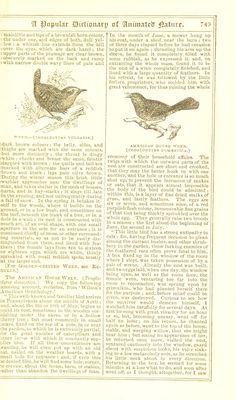
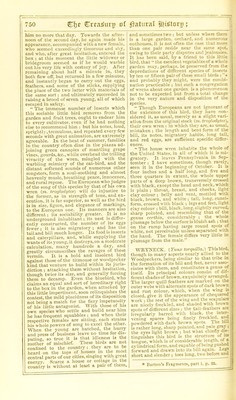
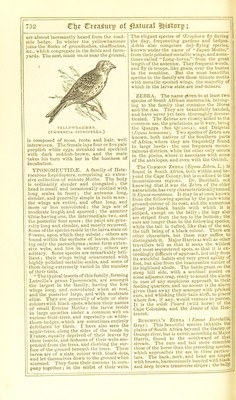
![maudihle and tips of a brownish horn colour, the under one, and edges of both, dull yel- low ; a whitish line extends from the bill over the eyes, which are dark hazel; the . upper parts of the plumage are clear brown, obscurely marked on the back and rump jwith narrow double wavy lines of pale and WREN.—(TROGLODYTES VOLOARI8.) dark brown colours: the belly, sides, and thighs are marked with the same colours, but more distinctly ; the throat is dingy rwhite ; cheeks and breast the same, faintly dappled with brown ; the quills and tail are marked with alternate bars of a reddish brown and black ; legs pale olive brown. During the winter season this brisk little ■warbler approaches near the dwellings of man, and takes shelter in the roofs of houses, barns, and in hay-stacks ; it sings till late in the evening, and not unfrequeutly during • a fall of snow. In the spring it betakes it- self to the woods, where it builds on the ground, or in a low bush, and sometimes on the turf, beneath the trunk of a tree, or in a hole in a wall ; its nest is constructed with I much art. of an oval shape, with one small | aperture in the side for an entrance ; it is composed chiefly of moss, or other surround- ing materials, so as not to be easily dis- tinguished from them, and lined with fea- thers : the female lays from ten to sixteen or eighteen eggs, which are white, thinly sprinkled with small reddish spots, mostly at the larger end. [For Golden-crested Week, see Re- sells.] The America* House Wrex. {Troglo- dytes domesticu.) We copy the following amusing account, verbatim, from ‘ Wilson’s American Ornithology.’ “ This well-known and familiar bird arrives in Pennsylvania about the middle of April; and, about the 8th or 10th of May, begins to ouild its nest, sometimes in the wooden cor- nishing under the eaves, or in a hollow iherry tree ; but most commonly in small ooxes, fixed on the top of a pole, in or near ;he garden, to which he is extremely partial, cor the great number of caterpillars and otner larva* with which it constantly sup- plies him. If all these conveniences are wanting, he will even put up with an old .iat, nailed on the weather boards, with a •mall hole for entrance ; and, if even this oe denied him, he will find some hole, corner, ■>r crevice, about the house, bam, or stables, ■ ather than abandon the dwellings of man. In the month of June, a mower hung up his coat, under a shed, near the barn ; two or three days elapsed before he had occasion to put it on again ; thrusting his arm up the sleeve, he fouud it completely filled with some rubbish, as he expressed it, and, on extracting the whole mass, found it to be the nest of a wren completely finished, and lined with a large quantity of feathers. In his retreat, he wus followed by the little forlorn proprietors, who scolded him with great vehemence, for thus ruining the whole AMERICAN HOUSE WREN. (TROGLODYTES DOMESTIOA.) economy of their household affairs. The twigs with which the outward parts of the nest are constructed are short and crooked, that they may the better hook in with one another, and the hole or entrance is so much shut up, to prevent the intrusion of snakes or cats, that it appears almost impossible the body of. the bird could be admitted; within this, is a layer of tine dried stalks of grass, and lastly feathers. The eggs are six or seven, and sometimes nine, of a red purplish flesh colour, innumerable fine grains of that tint being thickly sprinkled over the whole egg. They generally raise two broods in a season ; the first about the beginning of June, the second in July. “This little bird has a strong antipathy to cats : for, having frequent occasion to glean among the currant bushes, and other shrub- bery in the garden, those lurking enemies of the leathered race often prove fatal to him. A box fixed up in the window of the room where I slept, was taken possession of by a pair of wrens. Already the nest was built, and two eggs laid, when one day, the window being open, as well as the room door, the female wren, venturing too far into the room to reconnoitre, was sprung upon by grimalkin, who had planted herself there for the purpose ; and, before relief could be given, was destroyed. Curious to see how the survivor would demean himself, I watched him carefully for several days. At first he sung with great vivacity for an hour or so, but, becoming uneasy, went off for half an hour; on his return, he chanted again us before, went to the top of the house, stable, and weeping willow, that she might hear him ; but seeing no appearance of her, he returned once more, visited the nest, ventured cautiously into the window, gazed about with suspicious looks, his voice sink- ing to a low melancholy note, as he stretched his little neck about in every direction. Returning to the box, he seemed for some minutes ut a loss what to do, and soon after went off, as I thought, altogether, for I saw](https://iiif.wellcomecollection.org/image/b24864201_0771.jp2/full/800%2C/0/default.jpg)