The treasury of natural history, or, A popular dictionary of zoology / by Samuel Maunder.
- Maunder, Samuel, 1785-1849.
- Date:
- 1870
Licence: Public Domain Mark
Credit: The treasury of natural history, or, A popular dictionary of zoology / by Samuel Maunder. Source: Wellcome Collection.
773/856 (page 751)
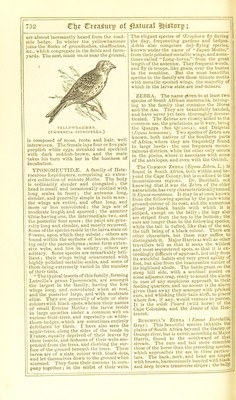
![two behind ; the claws sharp, much hooked, and formed for climbing branches of trees, on which it cun run with the utmost facility. The Wryneck is found in various parts of WRYNKQI.—(TONX TOIlQOIU.A.y Europe, and generally precedes the Cuckoo a few days Its food consists chiefly of ants and other Insects, of which it finds great .abundance lodged in the bark and crevices •of trees. XANTHu. A genus of Brachyurous < Crustaceans, of which there are numerous •species, extensively distributed. The cara- pace id very wide, but never regularly ovoid, rand not very convex. They are arranged by .Milne Edwards into those species whose carapace is grunulous or tuberculous above — and those species whose carrapace is not co- vered either with granulations or tubercles. • One species, Xanthnjloridus, about two inches m length, of a reddish brown colour, with dock claws, is common on the English and 1 French coasts. XAXTIIORXUS. The generic name used l oy Brisson for certain American birds. [See • JttlOLE, BaLTIMOUK.] XENOPS. The name used by Illiger for • i genus of Fissiroctral birds of South Ame- r ic& ; one species of which (Xenopg geni- ► Hirbis) is thus described by Mr. Swainson : i ibove reddi'h, beneath gray-brown ; chin, t yebrows, and spots on the throat and breast •vhitish ; beneath the ears a snowy spot; I esser quills blackish, the base fulvous, the t ips and margins rufous. Mr. Swainson r emarks that this extraordinary and not in- i legant little creature has u bill totallv dif- I erent from that of any other bird. Its ge- i ;eral habit, he states, evinces a close con- nection with the Sitt'-c, particularly those of sew Holland : wine of which have their bills which are slender) slightly inclining up- wards, thus forming a connection between t 'enup* and the straight-billed Silice of the •Id VV'orld. ’ XIPIIIAS. [See 8word-Fisii.] XIPHODON. [See Suppleiiext.] XYLOCOPA. A genus of Ilymcnoptera, [ 'oni their habits termed Carpenter Jiets r ’hey have very thick covering of hairs upon ie lurid legs of the femuics, which are used • y them as pollen-brushes. They form their nests in crevices of old walls or in sunny banks ; their cells arc composed of earth, and are very smooth in the inside, and the mouth of the nest is closed with tire sume material. Their wings are most commonly black, with a fine purple or violet gloss. XYLOPIIAGA. A genus of small Con- chiferous Molluscs, very similar to those of Teredo, and which are found in light wood that the animals have penetrated to the depth of about an inch. The valves are equal, globose, inequilateral, and closed at the back ; they have no calcareous tube, but two small aeeessory testaceous pieces placed near the hinge, and one small tooth in each valve. XYLOPTIAGI. A family of insects of the order Coleoptera Tetrnmera, distinguished from the Weevils by the ahsenee of a pro- boscis. These insects generally live in wood, which is perforated und channelled in va- rious directions by their lurvie. The dif- ferent species commit their ravages on various kinds of trees, some feeding on pines and firs, others on olives, and some restricting them- selves to fungi. [See Scolytid.e.] XYLOPIIILI. An extensi ve scries of gigantic Coleopterous insects, the mules of which are particularly distinguished by va- rious singular protuberances, horns or tu- bercles, arising from the head und thorax. They reside for the most part in tropical regions, and some of them acquire an immense size. [See Dynastid.e and Rutemd^e.] XYPHOSURA. A sub-class of Crustacea, 1 so called from the long tail-like spine, so 1 churueteristic a mark of the King-Crab. ! There is only one well-marked genus of this group, which will be found described under the head of Limulus. YAK. (Poephogns grunniens.) A species of Ox found in Thibet, among the mountains ; the bushy white tail is much prized in the East, where it is used to brush away flies, and also as an emblem of authority. YARKE. The native name of different South American monkeys of the genus Pi- thccia. \ ELLOWTIAMMER. (Embcriza citri- nctla.) This Passerine bird, which is about seven inches in length, is found u resident in this country, and generally throughout Eu- rope. The male is known by the head, cheeks, front of the neck, belly, and tail-coverts being of a bright yellow ; on the breast und bides reddish spots, which on the sides leuve a black streak in the centre. Feathers of the top of the back, blackish in the middle, ami reddish-brown on the Bides ; those on the rump bright chesnut, terminated with grayish ; tail-feathers blackish, the two lu- terul ones with a conical white spot on the inner barbs. Feet yellowish. The funule is smaller than the male ; und the yellow of the head, throat, and neck more thickly /narked with the brown and olive spots with which those parts are sprinkled. Their food consists of gruin, seeds, und insects. In summer the well-known notes of the male](https://iiif.wellcomecollection.org/image/b24864201_0773.jp2/full/800%2C/0/default.jpg)