The treasury of natural history, or, A popular dictionary of zoology / by Samuel Maunder.
- Maunder, Samuel, 1785-1849.
- Date:
- 1870
Licence: Public Domain Mark
Credit: The treasury of natural history, or, A popular dictionary of zoology / by Samuel Maunder. Source: Wellcome Collection.
775/856 (page 753)
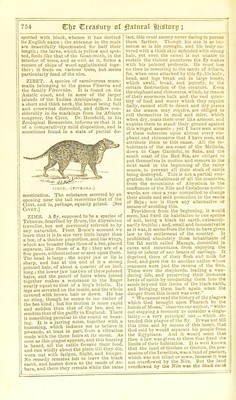
![ai'.d logs are pure white : there are obscure traces of black transverse markings on the arm. .Major Harris, who had so many op- portunities of seeing this fine species in a state of nature, remarks that, “ beautifully clad by the hand of nature, possessing much of tin- graceful symmetry of the horse, with great bone and muscular power, united to easy and stylish action—thus combining comeliness of figure with solidity of form, this species, if subjugated and domesticated, would assuredly make the best pony in the world. Although it admits of being tamed to a certain extent with considerable facility, —a half-domesticated specimen with a jockey on its brindled back being occasionally ex- posed in Cape Town for sale, —it has hitherto contrived to evade the yoke of servitude. ... The voice of this free-born 6on of the desert has no analogy to the discordant I braying of the a.ss, but consists of a shrill , abrupt neigh, which may be likened to the barking of a dog, ns heard by a passer by, | from the interior of a house. The senses of sight, hearing, and smell arc extremely de- | licate. The slightest noise or motion, no less than the appearance of any object that 1 is unfamiliar, at once rivets their gaze, and causes them to stop and listen with the ut- most attention ; any taint in the air equally attracting their olfactory organs. Instinct having taught these beuutiful animals that in union consists their strength, they com- i bine in a compact body when menaced by | an attack either from man or beast; and, if overtaken by the foe, they unite for mutual defence, with their heads together in a close circular band, presenting their heels to the i enemy, and dealing out kicks in equal force ' and abundance. Beset on ull sides, or pur- tialiy crippled, they rear on their hinder legs, fly at the adversar- with jaws distended, and use both teeth and heels with the greatest 1 freedom.”—//orris, ‘ (Jam*- and Wild Ani- ' vials of South Africa' p. 19. It is called Bontc, Quaat/a by the Cape Colonists, and PtuLsey by the Bechuanas. ZEBU. The name given to the humped ' varieties of oxen which are found in India ami the Asiatic Islands, and extend along : the eastern coast of Africa to the Cape of , Good Hope. They are used as beasts of ! burden, and serve as articles of food though . in this respect its flesh is by no means equal t to that of our domestic breeds. The hump, which is chiefly composed of fat, is regarded | as a great delicacy. Zebus differ greatly in dimensions ; some are of large size, while others, of which we have figured a female ami young, are not much larger than a sheep : 7SBO, they vary in colour; the most common variety is of a light gray, passing into cream-colour. I he Hindoos treat the larger breed with su- perstitious veneration. [SeeBrahmin Bull.] ZEE-KOE. The name given by the Dutch colonists in South Africa to the Hippopotu- mus. [See Hippopotamus.] ZERDA. [See Fennec.] ZEUGLODON. [See Supplement.] ZEUS, ZEIDyE. A genus and family of Aeanthopterygiuus fishes, remarkable for their compressed form ; to this group belongs the John Dory and the Opah Dory {Zeus Opaii) which latter is a very superb speeies, and inhabits the seas of warm regions, being only an occasional visitant of the Mediterra- nean and Northern seas. In size it exceeds every other species, measuring between four and five feet in length; in colour it appears to vary, the ground being sometimes a brilliant silvery green, and sometimes a bright gold- colour ; but in either case the body is vurie- gated on the sides with pretty numerous oval white spots, while the fins and tail are bright scarlet. The skin is apparently destitute of scales, and perfectly smooth. Two or three in- stances have occurred of this very beautifully coloured species having been taken on the British coast; one, which weighed between seventy uiul eighty pounds, was thrown upon the sands at Blyth, near Newcastle, in 17(19 ; the colours and beauty of which are stated to “beggar all description ; the upper part being of a bright green, variegated with whitish spots, and enriched with a shining golden hue, like the splendour of'a peacock's feather.” Another specimen v/us caught at Brixlmtn, in Torbay, in 1772, which “weighed a hundred and forty pounds, measuring four feet and u half in length, and two feet and a quarter in breath : its greatest thickness was only four inches, und the general colour was a vivid transparent scarlet varnish over burnished gold, bespunglcd with oval silver Bpots of various sizes.” [See Dory.] ZEUZERA. A genus of nocturnal I.cpi- doptera, two species of which are found in this country, one of these, however, is ex- tremely rare ; the more common species, the VVood-leopurd, (.Zeuzera jEsculi) is wuile ami C](https://iiif.wellcomecollection.org/image/b24864201_0775.jp2/full/800%2C/0/default.jpg)