The treasury of natural history, or, A popular dictionary of zoology / by Samuel Maunder.
- Maunder, Samuel, 1785-1849.
- Date:
- 1870
Licence: Public Domain Mark
Credit: The treasury of natural history, or, A popular dictionary of zoology / by Samuel Maunder. Source: Wellcome Collection.
776/856 (page 754)
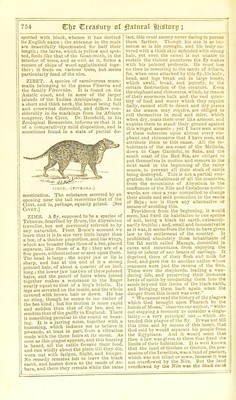
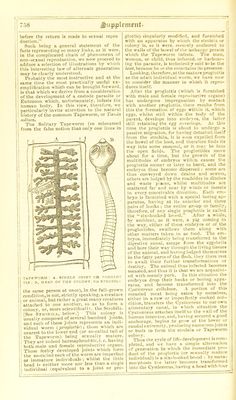
![spotted with black, whence it has derived its English name : the antennre in the male are beautifully bipcctinated for half their length ; the larva, which is yellow and spot- ted, feeds like that of the Goat-moth, in the interior of trees, and as well as it, forms a cocoon of chips of wood agglutinated toge- ther ; it feeds on various trees, but seems particularly fond of the elm. ZIBET. A species of carnivorous mam- malia belonging to the genus Vivei-ra. and the family Viverridcv. It is found on the Asiatic coast, and in some of the larger islands of the Indian Archipelago. It has a short and thick neck, the breast being full and somewhat distended, and differs con- siderably in its markings from its African congener, the Civet. Dr. Ilorsfield, in his Zoological Researches, informs us that it is of a comparatively mild disposition, and is sometimes found in a state of partial do- ZIBET. -(VtVBRRA.) mestication. The substance secreted by an opening near the tail resembles that of the Civet, and is, perhaps, equally prized. [See Civet.] ZIMB. A fly, supposed to be a species of Tabanus, described by Bruce, the Abyssinian traveller, but not previously referred to by any naturalist. From Bruce’s account we learn that it is in size very little larger than a bee, of a thicker proportion, and has wings, which are broader than those of a bee, placed separate, like those of a fly : they are of a fine gauze, without colour or spot upon them. The head is large ; the upper jaw or lip is sharp, and has at the end of it a strong pointed hair, of about a quarter of an inch long ; the lower jaw has two of these pointed hairs, and the pencil of lmirs when joined together makes a resistance to the finger nearly equal to that of a hog’s bristle. Its legs are serrated on the inside, and the whole covered with brown hair or down. lie has no sting, though he seems to me rather of the bee kind ; but his motion is more rapid and sudden than that of the bee, and re- sembles that of the gadfly in England. There is something peculiar in the sound or buzz- ing. It is a jarring noise, together with a humming, which induces me to believe it proceeds, at least in part, from a vibration made with the three hairs at its snout. As soon as this plague appears, and this buzzing is heard, all the cattle forsake their food, j and run wildly about the plain till they die, worn out with fatigue, fright, and hunger. No remedy remains but to leave the black earth, and hasten down to the sands of At- bara, aud there they remain while the rains last, thu cruel enemy never daring to pursue them farther. Though bis tize is as im- mense as is bis strength, and bis body co- vered with a thick skin defended with strong ; hair, yet even the camel is not unable to sustain the violent punctures the fly makes with bis pointed proboscis. He nnut lose no time in removing to the sands of Atbara, for, when once attacked by this fly, kisbody, head, and legs break out in large bos*r», which swell, break, and putrefy, to the certain destruction of the creature. Even the elephant and rhinoceros, which, by reason of their enormous bulk and the vast quan- tity of food and water which they reauire daily, cannot shift to desert and dry places as the season may require, are obliged to roll themselves in mud and mire, which when dry, coats them over like armour, and enables them to stand their ground against this winged assassin ; yet I have seen some of these tubercles upon almost every ele- phant and rhinoceros that I have seen, and attribute them to this cause. All the in- habitants of the sea-coast of the Melinda, down to Cape Gardefui, to Saba, and the south coast of the Red Sea, are obliged to put themselves in motion and remove to the next sand in the beginning of the rainy season, to prevent all their stock of cattle being destroyed. This is not a partial emi- gration, the inhabitants of all the countries, from the mountains of Abyssinia to the confluence of the Nile and Cestaboras north- wards, are once a year compelled to change their abode and seek protection in the sands of Beja; nor is there any alternative or means of avoiding this. Providence from the beginning, it would seem, had fixed its habitation to une species of soil, being a black fat earth, extraordi- narily fruitful; and, small and inconceivable as it was, it seems from the first to have given law to the settlement of the country. It prohibited absolutely those inhabitants of the fat earth called Mazaga, domiciled in caves and mountains, from enjoying the help or labour of any beasts of carriage. It deprived them of their flesh and^milk for food, and gave rise to another nation whose manners were just the reverse of the fir>u These were the shepherds, leading a wan- dering life, and preserving their immense herds of cattle by conducting them into the sands beyond the limits of the black earth, and bringing them back again^ when the danger from this insect was over. “ We cannot read the history of the plagues which God brought upon Pharaoh by the hands of Moses,’’ observes our author, “ with- out stopping a moment to consider a singu- larity— a very principal one — which at- , tended this plague of the fly. It was not till I this time, and by means of this insect, that God said he would separate his people from j the Egyptians. And it would seem that then a law was given to them that fixed the limits of their habitation. It is well known that the land of Goshen or Gcshcn, the pot.- j session of the Israelites, was a land of pasture, which was not tilled or sown, liecauae it wm not overflowed by the Nile. But the land , overflowed by the Nile was the black ta*-ik](https://iiif.wellcomecollection.org/image/b24864201_0776.jp2/full/800%2C/0/default.jpg)