The treasury of natural history, or, A popular dictionary of zoology / by Samuel Maunder.
- Maunder, Samuel, 1785-1849.
- Date:
- 1870
Licence: Public Domain Mark
Credit: The treasury of natural history, or, A popular dictionary of zoology / by Samuel Maunder. Source: Wellcome Collection.
778/856 (page 756)
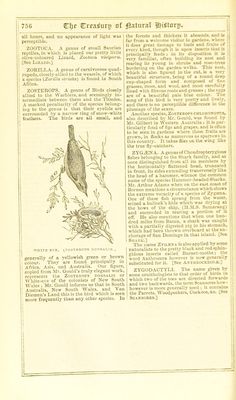
![all hours, and no appearance of light was perceptible. ZOOTOCA. A genus of small Saurian reptiles, in which is placed our pretty little olive-coloured Lizard, Zootuca vivipura. [See Lizaud.] ZOBILLA. A genus of carnivorous quad- I rupeds, closely allied to the weasels, of which 1 a species (Zorilla striata) is found in South Africa. ZOSTEROPS. A genus of Birds closely allied to the Warblers, and seemingly in- termediate between them and the Titmice. A marked peculiarity of the species belong- ing to the genus is that their eyelids are surrounded by a narrow ring of snow-white feathers. The birds are all small, and WHITE EYE. <ZOaTKROP8 DORSALIS., generally of a yellowish green or brown colour. They are found principally in Africa, Asia, and Australia. Our figure, copied from Mr. Gould’s truly elegant work, represents the Zosteuops dorsalis or White-eve of the colonists of New South Wales ; Mr. Gould informs us that in South 1 Australia, New South Wales, and Van Diemen’s Land this is the bird which is seen more frequently than any other species. In the forests and thickets it abounds, and it , far from a welcome visitor in gardens, where it does great damage to buds and fruiu of every kind, though it is upon insect* that it principally feeds ; in it* disposition it is very familiar, often building its nest and rearing its young in shrubs and rose-trees bordering on the garden welka. This nest, which is also figured in the cut, i* a very beautiful structure, being of a round deep cup-shaped form and composed of fine j grasses, moss, and wool, and most carefully lined with fibrous roots and grasses ; theezgs are of a beautiful pale blue colour. Toe song of this bird is very pretty and lively, and there is no perceptible difference in the plumage of the sexes. Another species, Zosterops chloeonotts also described by Mr. Gould, was found by Mr. Gilbert in Western Australia ; it is par- ticularly fond of figs and grapes, and is often to be seen in gardens where these fruiu are growm, in flocks as numerous as sparrows in this country. It takes flies on the wing like the true fly-catchers. ZYG-iENA. A genus of Chondropterygious fishes belonging to the Shark family, and at once distinguished from all its members by the horizontally flattened head, truncated in front, its sides extending transversely like the head of a hammer, whence the common name of the species Hammer-headed Sharks. Mr. Arthur Adams when on the east coast of Borneo mentions a circumstance which shows the extreme voracity of a species of Zygiena- One of these fish sprang from the water, seized a bullock’s hide which was drying a: the bows of the ship, (H.M.S. Samarang) and succeeded in tearing a portion of it off. He also mentions that when one hun- dred miles from Batan, a shark was caught with a partially digested pig in his stomach, which had been thrown overboard at the an- chorage of San Domingo in that island. [See Shark.] ,. The name Ztg-BWA is also applied by some naturalists to the pretty black and redsphin- gidous insects called Burnet-moths; the word Anthrocera however is now generally substituted for it. [See Astueoceridju] ZYGODACTYLI. The name given by some ornithologists to that order of birds in which two of the toes are directed forwards and two backwards, the term Scansores how- however is more generally used ; it contains the Parrots, Woodpeckers, Cuckoos, fcc. [see Scansores.]](https://iiif.wellcomecollection.org/image/b24864201_0778.jp2/full/800%2C/0/default.jpg)