The treasury of natural history, or, A popular dictionary of zoology / by Samuel Maunder.
- Maunder, Samuel, 1785-1849.
- Date:
- 1870
Licence: Public Domain Mark
Credit: The treasury of natural history, or, A popular dictionary of zoology / by Samuel Maunder. Source: Wellcome Collection.
779/856 (page 757)
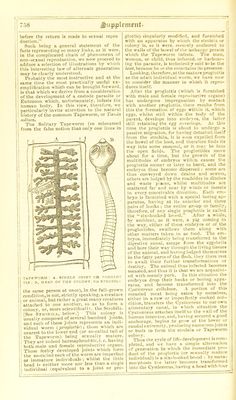
![I I 1 SUPPLEMENT. » j ACTINOTROCIIA. A generic name given by J. Muller to a murine animalcule, which is in all probability the larva of un Echinoderm allied to the common Sea- urchin. The creature is about the l-40th of an inch in length, highly transparent, furnished with numerous tentucula, and clothed with a series of active vibratile cilia. Individuals were first discovered on our own shores by Dr. Cobbold, F.L.S., by whom also they were carefully figured and described in the sixth volume of the Transactions of the London Microscopical Society, to which we mint refer our readers who desire further information. ALTERNATION- OF GENERATION. Ai the term Parthenogenesis is now generally employed in a more restricted sense than I originally intended by its distinguished framer [see Paictii knoc.kkbsis, helnw], it is here pro|»03ed to explain in detuil the phe- I nomena of nou-stxual reproduction gene- rally. The above title does not correctly embrace all the phenomena of reproduction without the direct influence of the male, hut until a more comprehensive general term be employed, it is certainly most convenient to describe these changes under the present head. It is in the lower unimals only that we find the ordinary sexual reproductive process superseded by the non-sexual production of individuals. Even in these the phenomena are comparatively rare. Nevertheless they are by no means accidental, but, as You Sieboid remarks, have a definite position in the history of the development of organic beings, being especially manifested in the Ccelenterata, the cestode and trematode En- toza, und in certain families of Insecta. Perhaps the true relation of the direct and ! indirect processes of generation will be better i understood by presenting all the phenomena of development in a tabulated form, us has I been done by Prof. Iluxlej', thus : — Continuous ^ Agamogenesis ) Discontinuous . (Gemmation with fission). (Gamogenesis. ( Growth. J Metamorphosis, j Gemmation \ i without fission). J Metagenesis. I Parthenogenesis. By anmogenesis is understood “ sexual re- production ;by agamogenesis, the nou- scx-ial process. When the producing indi- vidual (or protozooid) bus no sexual organs, Prof. Owen's tt-rin metagenesis may lie em- ployed; but when there are sexual organs, and the buils resemble ova, then Prof. Huxley adopts the term Parthenogenesis in its re- stricted sense. The essential nature of the phenomena of alternate generation has been most ably described by Prof. Allen Thomson, of Glas- gow. who observes that it consist* in this, namely, that in some unimals *• the body or individual which is developed immediately from the ovum is not, in general, itself the bearer of the sexual organs, but nevertheless maintain* for u time an independent exist- ence, or presents the structural and functional characters of a separate or distinct individual. these characters often differing remarkably i from those of the sexual individuals front 1 which the ovum derived its origin ; and that subsequently this individual, or one or other of its successors, has formed in con- j nection with it. either internally or exter- nally, and without sexual organs, a new progeny, which may consist of one or of, many individuals, which have each of them more of the structure und properties of inde- ■ pendent unimals, and which, however vari- I able their organisation may he, present this ' in common, that they are sexuully complete and renew the true generative act by the , formation of fecundated ovu. In some ani- j inals it is the immediate offspring of the j individual developed from the ovum which i resumes the sexual functions : in other ani- mals this offspring hears a second brood, or j a third, and even more successive generation*](https://iiif.wellcomecollection.org/image/b24864201_0779.jp2/full/800%2C/0/default.jpg)