The treasury of natural history, or, A popular dictionary of zoology / by Samuel Maunder.
- Maunder, Samuel, 1785-1849.
- Date:
- 1870
Licence: Public Domain Mark
Credit: The treasury of natural history, or, A popular dictionary of zoology / by Samuel Maunder. Source: Wellcome Collection.
782/856 (page 760)
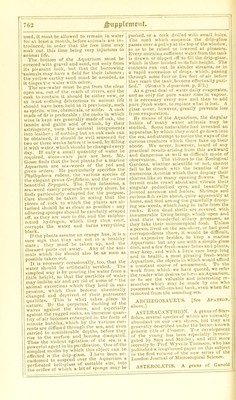
![: i Jmjiplrmmt. 760 tiny though liighlv organised insect mem- bers of the animal kingdom, whole genera- tions, sometimes eleven in succession, are reproduced from sexual parents, all of them being the product of a single ovum. This is brought about by a process of internal bud- ding in the parents, the extruded viviparous young being developed internally from egg- like bodies, which are not true ova and I have never undergone impregnation. The distinguished author above quoted describes the course of the generative process as fol- lows:— “Perfect male and femule winged insects are observed only towurds the autumn season. These fly ubout in great quantities; the impregnated females deposit their eggs, covered with a protecting case of mucus, in the axils and other recet-ses of plants, where they remain during the winter. In spring there are developed from these ova a brood of larvae, or imperfect female Aphides, which soon produce, by an act of viviparous gene- ration, and without any concurrence of the male sex, a progeny of a similar kind; and this is repented in successive generations for nine or ten times in the common species, or for ten or twelve weeks during the summer, at the end of which time the last brood brings forth male and perfect female indi- viduals, both of which die after having pro- vided, by the production of fecundated ova. for the continued generation during the next season.” I I rIAORAMS TO ILLUSTRATE THE DEVELOP I WEST OF OAMI’ANDUBIA AND APB18. In the accompanying diagram a represent* the spermatazoou fertilising the ovum ft), which gives riae to d, the fir«t embryo or viviparous larva. This larva give* origin to eight somewhat differently formed larvae whilst each one of these in their turn pro- duces eight others,and soon, until the sue- 1 gessive progenies are completed; the last giving birth to true sexual individual*, a pair of which are here drawn. A being the i mule and i the female. The mvltittadu larval Plant-lice thus produced from a : single ovum, though not defying calculation on paper, yet almost defies the imagination ! to conceive. This process, while it consti- tutes a true parthenogenesis, is not only ; remarkable as occurring in creatures so high : in the scale of animal organisation, but also ' on account of the very close reaen blance which obtains in the mode of the formation of the young of these viviparous larvae as compared with the mode of formation of the eggs within the body of the true sexually mature female. In both creatures there are special organs which give rise to the germs; but in the non-fertilised broods, or vivi- parous larva, they may be compared to a multitude of buds capatde of attaining the development and appearance of full-grown insects, which latter differ from the perfect insect chiefly in their usually not possessing any wings, and having imperfect reproduc- tive organs. Those who desire to make themselves acquainted with the intimate structural or histological changes which the germs un- dergo during their development within the body of the viviparous larvae, should consult Prof. Huxley’s elaborate memoir, “On the Reproduction of the Aphides,” in the 22nd | volum5 of the Linnsean Society’s Transac- tions. AMPniCCELIA. A term applied by Prof. Owen to a group of extinct Crocodile?, 1 whose backbone consists of vertebra which | are concave or hollowed out at both ends, j They were furnished with long slender jaws like the existing “Gaviul ” of the Ganges: the earliest known fossils being found in the ‘ lias formation Toe Tcleoeaurms may be taken as a type [which see, at p. 606]. AMPHICYON. A genus of extinct mam- mals, whose fossil remains occur in the , miocene deposits of Southern France. They 1 appear to have belonged to the plantigrade I carnivora, i. c. to those flesh-eating quadiu- , peds which walk on the soles of their feet, such as the Bears. Two species arc known, the A. gigaiitcus, and A. diajJioru*. Toe latter is found at Eppelsheim, ami lias been described by Kaup as a species of G'tilo. AMPMTIIERIUM. A highly interest- ing genus of Insectivorous mammalia only known in a fossil state. The animals of this • genus seem to be the most ancient represents- tivesof their order on the globe : the reniBii s of them were by some naturalists believe! to hnvc belonged to extinct species of reptiles or other cold-blooded oviparous animals. 1 Cuvier nt first sight determined the jaw j of one ot these to lmve belonged to a marsu- ]](https://iiif.wellcomecollection.org/image/b24864201_0782.jp2/full/800%2C/0/default.jpg)