A case of sarcoma of the thyroid gland / by J. Solis-Cohen.
- Solis-Cohen, J.
- Date:
- 1889
Licence: Public Domain Mark
Credit: A case of sarcoma of the thyroid gland / by J. Solis-Cohen. Source: Wellcome Collection.
Provider: This material has been provided by The University of Glasgow Library. The original may be consulted at The University of Glasgow Library.
5/10 page 3
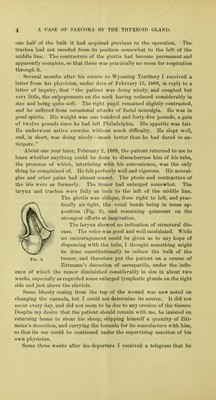
![protiahility have perished through inability to obey instructions necessary —to place his neck in a favorable position and to cough out the blood as it flooded the air-passage. On account of the bend in the trachea, it was found impossible to introduce the cannula with the aid of the ordinary pilot conductors. Trousseau's dilator and Golding-Bird's dilator both failed; but with the three-valved dilator of Laborde, fortunately at hand, it was found practicable to keep the opening patent and to push the im- peding swelling to one side, so as to admit of the introduction of the tube. The patient professed to have experienced no pain whatever dur- ing the operation, pain having probably been deadenecf by the attending excitement. The condition of the parts was such as to justify the infer- ence that the cervical vessels were involved in the growth, thus preclud- ing attempts at extirpation of the mass in the future. The neuralgia of the right eye ceased with the operation and did not return, and the heat and perspiration of the face diminished considerably. The ptosis and contraction of pupil remained uninfluenced. Before tbe wound was dressed, the exposed portion of the diseased gland was dusted with potassium-chlorate powder. This produced con- siderable disintegration of a portion of the mass which discharged through the externa] wound, and the size of the tumor diminished to such an extent that, at the end of two weeks, the length of the tube had to be lessened by nearly half an inch, and the tracheal opening had receded a little toward the middle line of tbe neck. I kept the patient under observation for about six weeks, during which time he progressed very satisfactorily in every way, except that the clonic spasm of the left vocal band soon became tonic, with permanent occlusion of the glottis to a very narrow slit totally insuflScient for respiration (Fig. 2). It appeared in this instance, as I have noticed in similar ones, that as soon as the artificial opening in the trachea insured access of air to the lungs in sufficient quantity, the forced contractions of the dilating muscles of the glottis, in the struggles for breath, subsided, and the spasm became permanent and un- opposed. I considered the condition to be spasm of the laryngeal muscles, rather than paralysis of the posterior orico-arytenoids, because of the tense condition of the edges of the vocal bands and the backward position of the aryte- Fig. 2. noid cartilages—physical conditions which require active contraction of portions of the posterior crico-arytenoid muscles. The voice was excellent as to modulation, but weak in intensity, reedy in tone, and produced only with considerable expiratory effort. About one month after the tracheotomy the i)atient complained of regurgitation of undigested food about three hours after the mid-day and evening meals. Whether this was due to pressure of the tumor upon the oesophagus, or to the presence of a diverticulum, remained undetermined, as the condition soon subsided and did not recur. The patient returned to his home with his tumor diminished to fully](https://iiif.wellcomecollection.org/image/b21462987_0005.jp2/full/800%2C/0/default.jpg)