General physiology : an outline of the science of life / by Max Verworn, tr. from the 2d German ed. and edited by Frederic S. Lee. With two hundred and eighty-five illustrations.
- Max Verworn
- Date:
- 1899
Licence: Public Domain Mark
Credit: General physiology : an outline of the science of life / by Max Verworn, tr. from the 2d German ed. and edited by Frederic S. Lee. With two hundred and eighty-five illustrations. Source: Wellcome Collection.
Provider: This material has been provided by The University of Leeds Library. The original may be consulted at The University of Leeds Library.
43/640 (page 23)
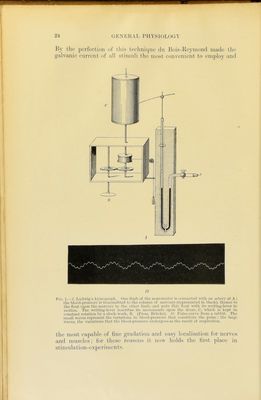
![if he were endowed with the hitter's superhuman power of hibour. Morpholofjy had become independent long before Miiller. boon after his death the course of physiology became divided and directed along ])urely chemical and \)\xve\y 2)hysical paths. Movement in the cJumical direction was guided by Wohler (1800-1882) and Liebig (1803-1873). In the year 1828 Wohler gave the theory of vital force its death-wound by his epoch-making synthesis, out of purely inorganic substances, of urea, a body produced in nature only by organisms. It had been believed that substances that were produced by the organism were produced only through the activity of vital force ; but here for the first time a very charac- teristic material product of the animal body was manufectured artificially in the chemical laboratory. This synthesis was soon followed by others. Justus von Liebig established new views regard- ing the metabolism of organisms ; and later Voit, Pfliiger, Zuntz, and others, advanced the theory of metabolism further, though not in entire agreement with one another. Physiological chemistry became more and more independent, partly under the influence of Mulder and Ijehmann, who first made a survey of the field, and especially under that of Kiihiie, who by his original methods and investigations, particularly upon the chemico-physiological relations of the proteids, diffused new light and expressed his conception of the science in his text-book. Finally, most recently, through the labours of Hoppe-Seyler, Hammersten, Bimge, Halliburton, Baumann, Kossel, and others, physiological chemistry as an inde- pendent science has quite cut itself loose from physiology, to the detriment of the latter. E. H. Weber (1795-1878), Volkmann (1801-1877), Ludwig (1816-1895), Helmholtz (1821-1894), du Bois-Reymond (1818- 1896), Marey, and others, led the movement in the j^hysical direc- tion. Ludwig mechanically transmitted the rhythmic changes of pressure of the pulse to a moving writing-lever, and made them record themselves upon the smooth surface of paper moved at a uniform rate (Fig. 1). He thus surpassed all others in creating a method of the greatest value in the investigation of the purely physical activities of the animal body. This gra])hic methorl proved so extremely fruitful that it found wide employment in physiology. It was used for the graphic representation of muscle-contraction, of respiratory movements, of the heart-beat, etc. In France, Marey developed it to unexpected completeness; so that now it serves as the most important method of investigation in all researches that deal with the phenomena of macroscopic movement. One other method became fundamentally important in physical physiology, namely, that of the comprehensive and ingenious technique of galvanic stimulation, which was created by E. du Bois-Reymond's classic researches upon the general physics of muscle and nerve.](https://iiif.wellcomecollection.org/image/b21506383_0043.jp2/full/800%2C/0/default.jpg)