General physiology : an outline of the science of life / by Max Verworn, tr. from the 2d German ed. and edited by Frederic S. Lee. With two hundred and eighty-five illustrations.
- Max Verworn
- Date:
- 1899
Licence: Public Domain Mark
Credit: General physiology : an outline of the science of life / by Max Verworn, tr. from the 2d German ed. and edited by Frederic S. Lee. With two hundred and eighty-five illustrations. Source: Wellcome Collection.
Provider: This material has been provided by The University of Leeds Library. The original may be consulted at The University of Leeds Library.
79/640 (page 59)
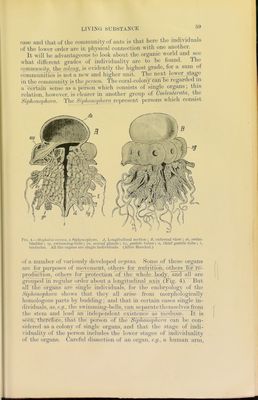
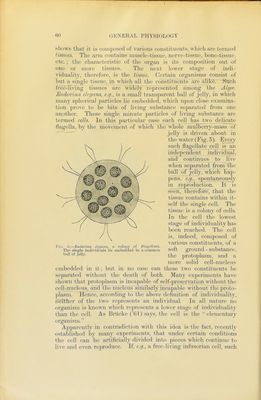
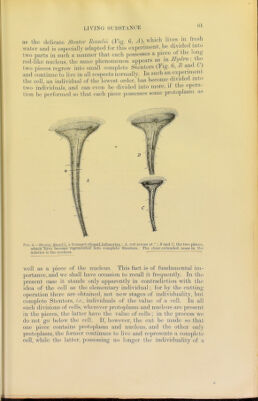
![case and that of the community of ants is that here the individuals of the lower order are in physical connection with one another. It will be advantageous to look about the organic world and see what different grades of individuality are to be found. The community, the colony, is evidently the highest grade, for a sum ot communities is not a new and higher unit. The next lower stage in the community is the iKvson. The coral-colony can be regarded m a certain sense as a person which consists of single organs; this relation, however, is clearer in another group of Coelenterata, the Siphonophora. The Siphonophora represent persons which consist Fio. 4.—SkphaUa roroiia, a Siphoiiriphoro. -•/, Longitudinal section ; ]i, oxternal view ; M), swim- bladder; Kfi, .swininiing-bells; no, sexual glands; Im, gastric tubes; o, chief gastric tube ; t, tentacles. All the organs are single individuals. (After Haeckel.) of a number of variously developed organs. Some of these organs are for purposes of movement, others for nutrition, otliCTsTor re- production, others for protection of the whole body, and all are grouped in regular order about a longitudinal a.xis (Fig. 4). But all the organs are single individuals, for the embryology of the Siphonophora shows that they all arise from morphologically homologous parts by budding; and that in certain cases single in- dividuals, as, c.i7.,the swimming-bells, can separate themselves from the stem and lead an independent existence as medusa^. It is seen, therefore, that the person of the Sip)honop)hora can be con- sidered as a colony of single organs, and that the stage of indi- viduality of the person includes the lower stages of individuality of the organs. Careful dissection of an organ, e.g., a human arm,](https://iiif.wellcomecollection.org/image/b21506383_0079.jp2/full/800%2C/0/default.jpg)