General physiology : an outline of the science of life / by Max Verworn, tr. from the 2d German ed. and edited by Frederic S. Lee. With two hundred and eighty-five illustrations.
- Max Verworn
- Date:
- 1899
Licence: Public Domain Mark
Credit: General physiology : an outline of the science of life / by Max Verworn, tr. from the 2d German ed. and edited by Frederic S. Lee. With two hundred and eighty-five illustrations. Source: Wellcome Collection.
Provider: This material has been provided by The University of Leeds Library. The original may be consulted at The University of Leeds Library.
80/640 (page 60)
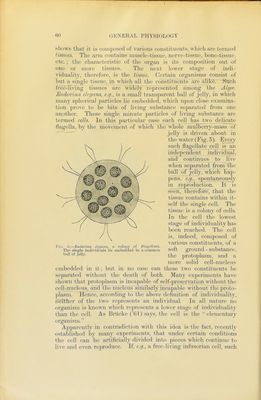
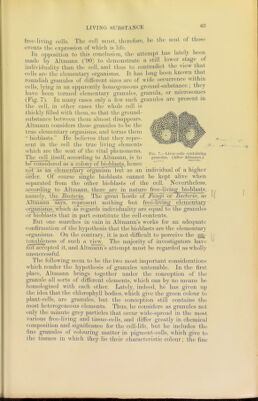
![shows that it is coiii])osed of various constituents, w hich are termed tissues. The arm contains muscle-tissue, nerve-tissue, bone-tissue, etc.; the characteristic of the organ is its composition out of one or more tissues. The next lower stage of indi- vidualit}', therefore, is the tissue. Certain organisms consist of but a single tissue, in which all the constituents are alike. Such free-living tissues are widely represented among the Algm. Eudorina elegans, e.g., is a small transparent ball of jelly, in which many spherical particles lie embedded, which upon close examina- tion prove to be bits of living substance separated from one another. These single minute particles of living substance are termed cells. In this particular case each cell has two delicate flagella, by the movement of which the whole mulberry-mass of ' ~ ^oWy is driven about in the water (Fig. 5). Every such flagellate cell is an independent individual, and continues to live when separated from the ball of jelly, which hap- pens, e.g., spontaneous!}' in reproduction. It is seen, therefore, that the tissue contains within it- self the single cell. The tissue is a colony of cells. In the cell the lowest stage of individuality has been reached. The cell is, indeed, composed of various constituents, of a soft ground - substance, the protoplasm, and a more solid cell-nucleus embedded in it; but in no case can these two constituents be separated without the death of both. Many experiments have shown that protoplasm is incapable of self-preservation without the cell-nucleus, and the nucleus similarly incapable without the proto- plasm. Hence, according to the above definition of individuality, neither of the two represents an individual. In all nature no organism is known which represents a lower stage of individuality than the cell. As Brlicke ('61) says, the cell is the elementary organism. Apparently in contradiction with this idea is the fact, recently established by many experiments, that under certain conditions the cell can be artificially divided into pieces which continue to live and even reproduce. If, e.g., a free-living infusorian cell, such Fuj. 5.—Eudorina elegans, a colony of Flagellata. The single individuals lie embedded in a common ball of jelly.](https://iiif.wellcomecollection.org/image/b21506383_0080.jp2/full/800%2C/0/default.jpg)