A lecture on toxicology : delivered before the class of the Medical College of Ohio, January 15, 1841 / by John Locke.
- John Locke
- Date:
- 1843
Licence: Public Domain Mark
Credit: A lecture on toxicology : delivered before the class of the Medical College of Ohio, January 15, 1841 / by John Locke. Source: Wellcome Collection.
Provider: This material has been provided by the National Library of Medicine (U.S.), through the Medical Heritage Library. The original may be consulted at the National Library of Medicine (U.S.)
17/20
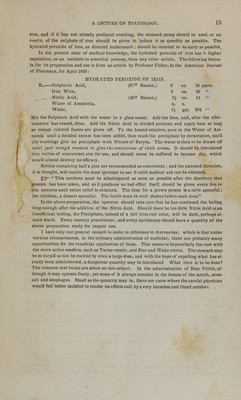
![sion, and if it has not already produced vomiting, the stomach pump should be used, or an emetic of the sulphate of zinc should lie given to Induce it as speedily as possible. The hydrated peroxide of iron, as directed underneath ; should be resorted to as early as possible. In the present state of medical knowledge, the hydrated peroxide of iron has a higher reputation, as an antidote to arsenical poisons, than any other article. The following formu- la for its preparation and use is from an article by Professor Fisher, in the American Journal of Pharmacy, for April 1840: HYDRATED PEROXIDE OF IRON. R. Sulphuric Acid, (67° Baume,) 8 oz. 16 parts. Iron Wire, 8 oz. 16 Nitric Acid, (49° Baume,) 5£ oz. 11 Water of Ammonia, q. s. Water, ]£ gal. 384 Mix the Sulphuric Acid with the water in a glass vessel. Add the Iron, and, after the effer- vescence has ceased, filter. Add the Nitric Acid in divided portions, and apply heat so long as orange colored fume? are given off. To the heated solution, pour in the Water of Am- monia until a decided excess has been added, then wash the precipitate by decantation, until the washings give no precipitate with Nitrate of Baryta. The water is then to be drawn off until just enough remains to give the consistence of thick cream. It should be introduced into bottles of convenient size for use, and should never be suffered to become dry, which would almost destroy its efficacy. Bottles containing half a pint are recommended as convenient; and the annexed direction, it is thought, will enable the most ignorant to use it until medical aid can be obtained. 55 This antidote must be administered as soon as possible after the discovery that arsenic has been taken, and as it produces no bad effect itself, should be given every five or ten minutes until entiie relief is obtained. The dose for a grown person is a table spoonful; for children, a dessert spoonful. The bottle must be well shaken before each dose. In the above preparation, the operator should take care that he has continued the boiling long enough after the addition of the Nitric Acid. Should there be too little Nitric Acid or an insufficient boiling, the Precipitate, instead of a full iron-rust color, will be dark,perhaps al- most black. Every country practitioner, and every apothecary should have a quantity of the above preparation ready for instant use. I have only one general remark to make in reference to Antidotes; which is that under various circumstances, in the ordinary administration of medicine, there are probabiy many opportunities for the beneficial application of them. This seems to bepecullarly the case with the more active emetics, such as Tartar-emetic, and Blue and Waite vitriol. The stomach may be so torpid as not be excited by even a large dose, and with the hope of expelling what has al- ready been administered, a dangerous quantity may be introduced What then is to be done? The common textbooks are silent on this subject. In the administration of Blue Vitriol, al- though it may operate freely, yet some of it always remains in the tissues of the mouth, stom- ach and esophagus. Small as the quantity may be, there are cases where the careful physician would feel better satisfied to render its effects null, by a very harmless and bland antidote](https://iiif.wellcomecollection.org/image/b21137456_0017.jp2/full/800%2C/0/default.jpg)




 No text description is available for this image
 No text description is available for this image
 No text description is available for this image