Content advisory
This digitised material is free to access, but contains information or visuals that may:
- include personal details of living individuals
- be upsetting or distressing
- be explicit or graphic
- include objects and images of objects decontextualised in a way that is offensive to the originating culture.
Licence: In copyright
Credit: Codon 1965. Source: Wellcome Collection.
7/75
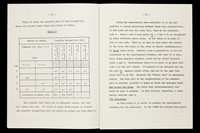
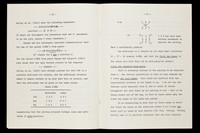
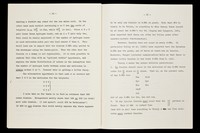
![Table II shows the possible sets of base-recognition which are allowed under these four kinds of wobble. TABLE II Nature of Wobble Possible Recognition Sets Standard Set plus I = Ü Ü = G I = A occurence in known code :] *.) i) This assumes that there are no ambiguous codons, and that all codons are used. If either of these restrictions is relaxed the possible recognition sets can easily be worked out from Table I. Using the experimental data available it is not yet possible to choose decisively between these four possibilities. If AUG codes Met and AUA codes lieu, then we can eliminate code 2. Codes 1 and 3 both permit UÌ , A and G to be recognised Cj by three different amino acids. So far there is no hint of this in the code. That is, we have no case where the doublet of the first two bases of the codon is shared (unambiguously) by three amino acids. However, such a possibility is not yet eliminated by the experimental evidence, and even if it were, this, being negative evidence, would not by itself disprove codes 1 and 3. Nevertheless there is no doubt in my mind that code 4 is the most likely. It explains in an unforced way why the pair A) appears rather often, and yet at the same time GJ allow lieu to be AUA. Moreover the wobble rule is remarkably simple. Any base pair in the neighbourhood of the standard pair is allowed, provided it makes at least two hydrogen bonds and is not too close . One feels that stereochemical^ this would be easy to arrange. In what follows, therefore, I shall mainly consider code 4. The Anticodons At this point it is useful to examine the experimental evidence for the anticodon. In the S-RNA for Alanine from yeast,](https://iiif.wellcomecollection.org/image/b18178583_PP_CRI_H_3_16_0007.jp2/full/800%2C/0/default.jpg)


 No text description is available for this image
 No text description is available for this image
 No text description is available for this image