Licence: Public Domain Mark
Credit: Elements of histology / by E. Klein. Source: Wellcome Collection.
Provider: This material has been provided by Royal College of Physicians, London. The original may be consulted at Royal College of Physicians, London.
24/396 (page 4)
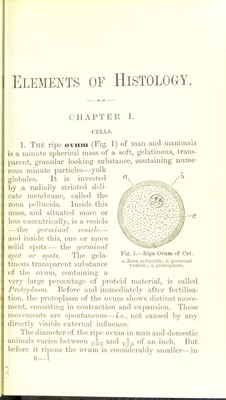
![(h'igs. 2, 3, 4), HO that aftei' a few days we find witliin the orif^inal investment of the ovum a large numl)er of minute (ihnneuts, each consisting of protoplasm, and each containing a nucleus. 3. Eroni these elements, which become smaller as the process of cleavage progresses, all parts and organs of the embryo and its membranes are formed. It can be easily shown that the individual elements possess the power of contractility. Either spontaneously or under the influence of moderate heat, electricity, mechanical or chemical stimulation, they throw out processes and withdraw them again, their substance flowing slowly but perceptibly along. Hence they can change their position. In this respect they com- ])letely resemble those lowest organisms which are known as amoebte, each of these being likewise a nucleated mass of protoplasm. Wherefore this move- ment is termed amceboid movement. It can be further shown that they, like amcebse, grow in size and divide —that is to say, the individuals of a generation grow in size before each gives rise to two new daughter individuals. 4. Although for some time during embryonic life the elements constituting the organs of the embryo are possessed of these characters, a time arrives when only a limited number of them retain the power of contractility in any marked degree. At birth only the white corpuscles of the blood and lymph, many of the elements of the lymphatic organs, and the muscular tissues, possess this power, while the others lose it, or at any rate do not show it except when dividing into two new elements. Some of these elements retain their protoplasmic basis ; as a rule, each con- tains one nucleus (but some two or more) and is capable of giving origin by division to a new genera- tion. Others, however, change their nature altogether, their protoplasm and nucleus disappear, and they](https://iiif.wellcomecollection.org/image/b24757238_0024.jp2/full/800%2C/0/default.jpg)