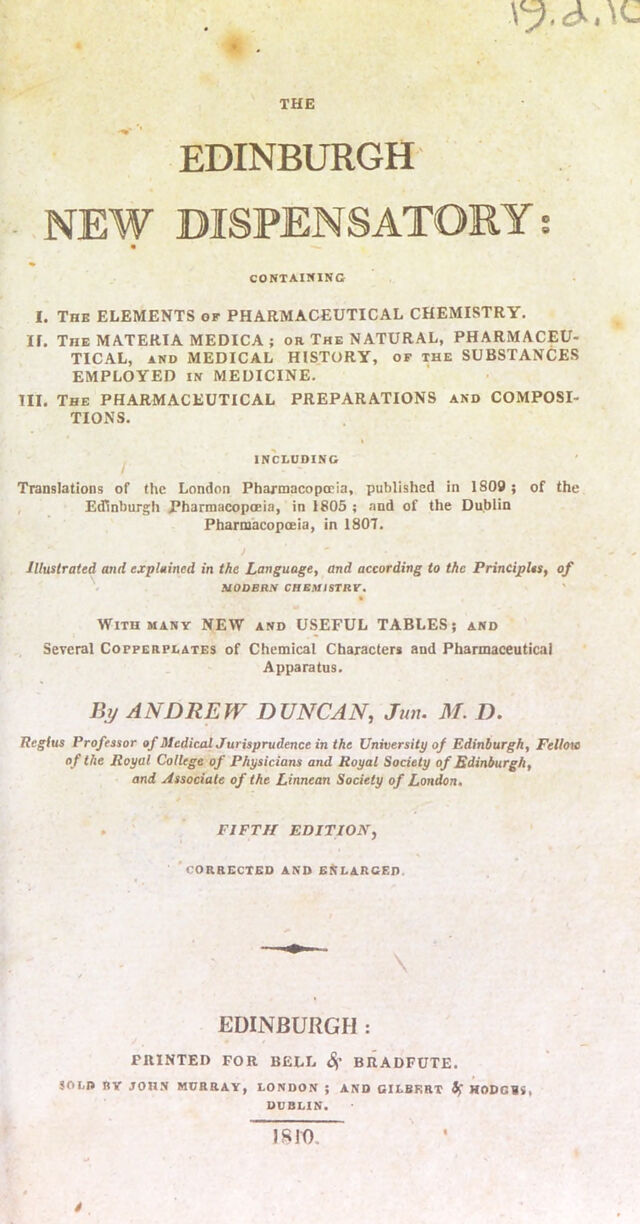
The Edinburgh new dispensatory : containing, I. The elements of pharmaceutical chemistry: II. The materia medica; or, The natural, pharmaceutical, and medical history, of the substances employed in medicine: III. The pharmaceutical preparations and compositions. Including translations of the London Pharmacopoeia, published in 1809 ; of the Edinburgh Pharmacopoeia, in 1805 ; and of the Dublin Pharmacopoeia, in 1807. Illustrated and explained in the language, and according to the principles, of modern chemistry. With many new and useful tables; and several copperplates of chemical characters and pharmaceutical apparatus / by Andrew Duncan.
- Andrew Duncan
- Date:
- 1810
Licence: Public Domain Mark
Credit: The Edinburgh new dispensatory : containing, I. The elements of pharmaceutical chemistry: II. The materia medica; or, The natural, pharmaceutical, and medical history, of the substances employed in medicine: III. The pharmaceutical preparations and compositions. Including translations of the London Pharmacopoeia, published in 1809 ; of the Edinburgh Pharmacopoeia, in 1805 ; and of the Dublin Pharmacopoeia, in 1807. Illustrated and explained in the language, and according to the principles, of modern chemistry. With many new and useful tables; and several copperplates of chemical characters and pharmaceutical apparatus / by Andrew Duncan. Source: Wellcome Collection.
Provider: This material has been provided by King’s College London. The original may be consulted at King’s College London.
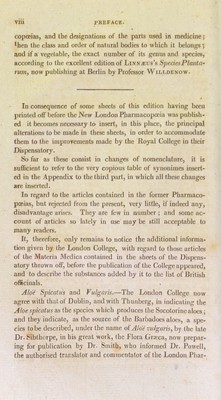
![copoeias, and the designations of the parts used in medicine; *^hen the c]ass and order of natural bodies to which it belongs and if a vegetable, the exact number of its genus and species, according to the excellent edition of Linn^us’s SpeciesPlanta- rumy now publishing at Berlin by Professor Willdenow. In consequence of some sheets of this edition having been printed off before the New London Pharmacopoeia was publish- ed it becomes necessary to insert, in this place, the principal alterations to be made in these sheets, in order to accommodate them to the improvements made by the Royal College in their Dispensatory. So far as these consist in changes of nomenclature, it is sufficient to refer to the very copious table of synonimes insert- ed in the Appendix to the third part, in which all these changes afe inserted. In regard to the articles contained in the former Pharmaco- poeias, but rejected from the present, very little, if indeed any, disadvantage arises. They are few in number; and some ac- count of articles so lately in use' may be still acceptable to many readers. It, therefore, only remains to notice the additional informa- tion given by the London College, with regard to those articles of the Materia Medica contained in the sheets of the Dispens- atory thrown off, before the publication of the College appeared, and to describe the substances added by it to the list of British ofScinals. Aloe Spicatus and Vulgaris.—The London College now agree with that of Dublin, and with Thunberg, in indicating the Aloe spicatus as the species which produces the Socotorine aloes; and they indicate, as the source of the Barbadoes aloes, a spe- cies to be described, under the name oi Aloe vulgarisy by the late Dr. Sibthorpe, in his great work, the Flora Graeca, now prepar- ing for publication by Dr. Smith, who informal Dr. Powell, the authorised translator and commentator of the London Phar-](https://iiif.wellcomecollection.org/image/b21304361_0010.jp2/full/800%2C/0/default.jpg)


 No text description is available for this image
 No text description is available for this image
 No text description is available for this image