Poultry breeding : theory and practice / by A.L. Hagedoorn and Geoffrey Sykes.
- Arend Lourens Hagedoorn
- Date:
- 1953
Licence: Attribution-NonCommercial-NoDerivatives 4.0 International (CC BY-NC-ND 4.0)
Credit: Poultry breeding : theory and practice / by A.L. Hagedoorn and Geoffrey Sykes. Source: Wellcome Collection.
46/256 (page 40)
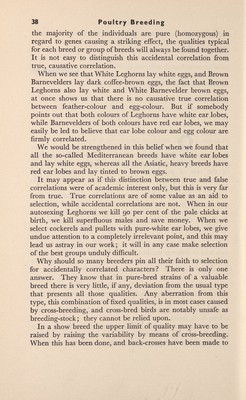
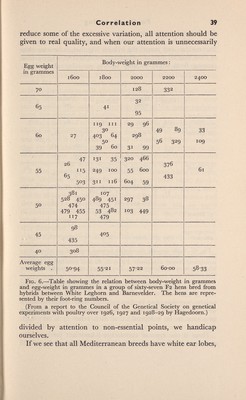
![40 Poultry Breeding this does not prove anything but that they have been selected deHberately for this point. When I mated White Leghorn to Barnevelder, and mated the hybrids together, it became clear at once that all sorts of correlations were broken. Egg colour, ranging from white to deep brown, ear-lobe colour, body- Fig. 7.—Table showing the relation between colour of ear lobes (white, almost white, half red, almost red and red) and egg-colour (white, cream, tinted, and brown) in a group of sixty-six F2 hens from hybrids between White Leghorn and Barnevelder. The hens are represented by their foot- ring numbers. (From a report [to the Council of the Genetical Society] on genetical experiments with poultry over 1926, 1927 and 1928-29 by Hagedoorn.) weight, egg size, age at first egg—all those qualities which were always seen together in the two different breeds—were now seen to be independent of each other to a very high degree. There is one type of correlation I have not yet treated— namely, causative correlation. Some adaptation of the animal](https://iiif.wellcomecollection.org/image/b18030804_0047.JP2/full/800%2C/0/default.jpg)