The laws of health : physiology, hygiene, stimulants, narcotics : for educational institutions and general readers / by Joseph C. Hutchison.
- Joseph Chrisman Hutchison
- Date:
- [1884], ©1884
Licence: Public Domain Mark
Credit: The laws of health : physiology, hygiene, stimulants, narcotics : for educational institutions and general readers / by Joseph C. Hutchison. Source: Wellcome Collection.
Provider: This material has been provided by the Francis A. Countway Library of Medicine, through the Medical Heritage Library. The original may be consulted at the Francis A. Countway Library of Medicine, Harvard Medical School.
68/240 (page 62)
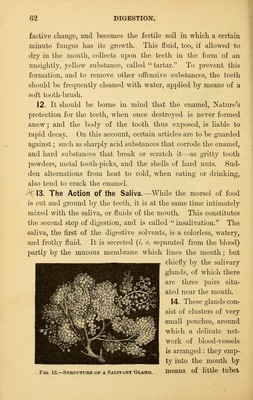
![factive change, and becomes the fertile soil in which a certain minute fungus has its growth. This fluid, too, if allowed to dry in the mouth, collects upon the teeth in the form of an unsightly, yellow substance, called tartar. To prevent this formation, and to remove other offensive substances, the teeth should be frequently cleaned with water, applied by means of a soft tooth-brush. 12. It should be borne in mind that the enamel, Nature's protection for the teeth, when once destroyed is never formed anew; and the body of the tooth thus exposed, is liable to rapid decay. On this account, certain articles are to be guarded against; such as sharply acid substances that corrode the enamel, and hard substances that break or scratch it—as gritty tooth powders, metal tooth-picks, and the shells of hard nuts. Sud- den alternations from heat to cold, when eating or drinking, also tend to crack the enamel. 13. The Action of the Saliva.—While the morsel of food is cut and ground by the teeth, it is at the same time intimately mixed with the saliva, or fluids of the mouth. This constitutes the second step of digestion, and is called insalivation. The saliva, the first of the digestive solvents, is a colorless, watery, and frothy fluid. It is secreted (?'. e. separated from the blood) partly by the mucous membrane which lines the mouth; but chiefly by the salivary glands, of which there are three pairs situ- ated near the mouth. 14. These glands con- sist of clusters of very small pouches, around which a delicate net- work of blood-vessels is arranged : they emp- ty into the mouth by Fig. 13.—Structure or a Salivary Gland. means of little tubeV BHP3 >*^i X ■ ; fr? ■ BwsEfcv. wmm-Ji .«©» _ ffSif) *rf~\*m PIKlliSi allll§v - %dafwStJ*alB?2@®^ immrn ' ***'y--St^ttm*^0] rra «nT7?I^? ■^SIS* la'i'^9. '?*} k~ytJK^t~m£S •SsfiSMr^l wWwMSmt* jTp^LZ^m -r-^-^SRg ^jfJl^k m*$H ^M0lp rngm l iM$IW™i- ^w£m& 1 isBy^pt-lB ^^jmmm^M^jmm -W^^ ^ -<i: ^-- _^< -js!b - : ^is» . _A.r:m* I ■^jQ&Sr^s - Jk 1 '5Mx2i|g 'Tim 4 h s, m mm™](https://iiif.wellcomecollection.org/image/b21060162_0068.jp2/full/800%2C/0/default.jpg)