The ready reference handbook of diseases of the skin / By George Thomas Jackson, ... With 99 illustrations and 4 plates.
- Date:
- 1906
Licence: In copyright
Credit: The ready reference handbook of diseases of the skin / By George Thomas Jackson, ... With 99 illustrations and 4 plates. Source: Wellcome Collection.
Provider: This material has been provided by the Royal College of Physicians of Edinburgh. The original may be consulted at the Royal College of Physicians of Edinburgh.
21/678 page 27
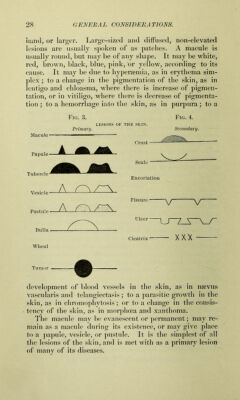
![amount of oil in the sweat. Sweat glands are most numer- ous in the palms and soles. Their diameter is from 0.3 to 0.4 mm. Tlie largest are in the axillae, where they have a diameter of 2 to 7 mm. and are very numerous. In the external meatus of the ear they seerete the so-called ear wax. Muscles. The skin is provided with muscles, both of the striated and unstriated variety. The striated muscles are found in the face and nose. The majority of the mus- cles of the skin are involuntary muscles. In the scrotum they run parallel with the raphe. On the penis and about the nipple their direction is circular. The ari'ectores pi- lorum muscles are found all over the body, running in a more or less oblique direction from the bottom of several pa])ill8e down and around a sebaceous gland to be attached to the bottom of a hair follicle. By contracting they raise the hairs to a ])erpendieular position and aid in pressing out the contents of the sebaceous glands. Diagnosis. The Lesions op the Skin. We speak of primary and secondary lesions of the skin. By the first of these terms we mean the form assumed by the efflorescence at its first appearance. By the second of these terms we mean the subsequent changes the primary lesion undergoes of itself, or as the result of extraneous causes acting upon it. In running its course, whether influenced by treat- ment or not, almost every disease of the skin exhibits more than one lesion, and we can only speak of it as a macular, jiapular, or other disease from its most prominent and characteristic lesion. The primary lesions of the skin are the macule, the papule, the tubercle, the vesicle, the pustule, the bulla, the wheal, and the tumor. Tlie secondary lesions of the skin are the crust, the scale, the excoriation, the fissure, the ulcer, and the cicatrix. These may be graphically repre- .sented, following Piffard.' Primary Lesions. A macule is a spot or stain of the skin which is not raised above its surface. It may be of any size from that of a pin-point to that of the palm of the ’ Cutaneous Memoranda. Wood, N. Y., 1885.](https://iiif.wellcomecollection.org/image/b21967581_0021.jp2/full/800%2C/0/default.jpg)
 No text description is available for this image
 No text description is available for this image
 No text description is available for this image