The ready reference handbook of diseases of the skin / By George Thomas Jackson, ... With 99 illustrations and 4 plates.
- Date:
- 1906
Licence: In copyright
Credit: The ready reference handbook of diseases of the skin / By George Thomas Jackson, ... With 99 illustrations and 4 plates. Source: Wellcome Collection.
Provider: This material has been provided by the Royal College of Physicians of Edinburgh. The original may be consulted at the Royal College of Physicians of Edinburgh.
23/678 page 29
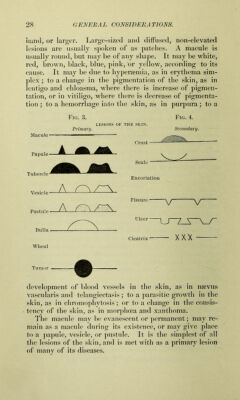
![The principal macular diseases are chloasma, chromo- ])liytosis, erytlicma simplex, lentigo, melasma, morphcea., nyevus simplex and spilus, purpura, scleroderma, vitiligo, and xanthoma. A papule is a circumscribed, solid elevation ot‘ the skin. In size it varies from that of a pin-point to tliat of a split pea. It may be of different colors, but is usually some shade of red. It is soft or firm to the touch. In form it may be acuminated, rounded, flattened, or umbilicated. Its base may be round, oval, or angular. It may be due to inflammation, as in eczema; to liypertrophy of normal structures, as in verruca; to tlie hea})ing up of epidermic cells about a hair follicle, as in keratosis pilaris ; or to the retention of sebaceous matter in a follicle, as in comedo and milium. The papule may remain as such throughout its course, and finally be absorbed; or it may change into a vesicle or pustule; or it may soften and break down. Papular diseases have received the name of lichenoid diseases, and at one time we had a goodly number of lichens. Most of these have now been placed under other headings, as it is recognized that they are but single mani- festations of other diseases. Papular diseases are apt to be scaly and itchy. The principal papular diseases are: lichen tropicus, lichen ruber acuminatus and planus, lichen scrofulosorum, lichen pilaris or keratosis pilaris, lichen urticatus or pap- ular urticaria, acne, comedo, milium, prurigo, and psoria- sis. Like the macule, the papule is found in many dis- eases that can not be classed as papular. A tubercle or nodule may be thought of as a large papule. Like it, it is a circumscribed solid elevation of the skin, usually of a reddi.sh color. Indeed, the difference between a papule and a tubercle is mainly arbitrary and for con- venience. Thus, we speak of a solid lesion up to the size of a split pea as a papule, while above that it is spoken of as a tubercle. Some lesions which are usually spoken of as tubercles, such as the tubercular syphilide, may not be larger than a split pea. Quite commonly, when a lesion is larger than a cherry it is spoken of as a](https://iiif.wellcomecollection.org/image/b21967581_0023.jp2/full/800%2C/0/default.jpg)
 No text description is available for this image
 No text description is available for this image
 No text description is available for this image