The ready reference handbook of diseases of the skin / By George Thomas Jackson, ... With 99 illustrations and 4 plates.
- Date:
- 1906
Licence: In copyright
Credit: The ready reference handbook of diseases of the skin / By George Thomas Jackson, ... With 99 illustrations and 4 plates. Source: Wellcome Collection.
Provider: This material has been provided by the Royal College of Physicians of Edinburgh. The original may be consulted at the Royal College of Physicians of Edinburgh.
71/678 page 77
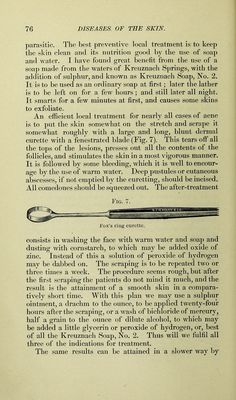
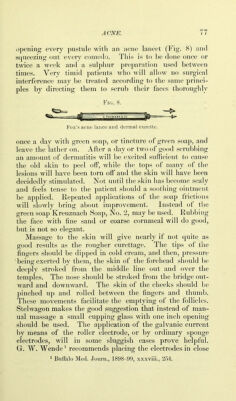
![opening every pustule with an acne lancet (Fig. 8) and squeezing out every comedo. This is to he done once or twice a week and a sulphur preparation used between times. Very timid patients who will allow no surgical interference may be treated according to the same princi- ples by directing them to scrub their faces thoroughly Fox’s acne lance and dermal curette. once a day with green soap, or tincture of green soap, and leave the lather on. After a day or two of good scrubbing an amount of dermatitis will be excited sufficient to cause the old skin to peel off, while the tops of many of tlie lesions will have been torn off and the skin will have been decidedly stimulated. Not until the skin has become scaly and feels tense to the patient should a soothing ointment be applied. Repeated applications of the soap frictions will slowly bring about improvement. Instead of tlie green soap Kreuznach Soaj), No. 2, may be used. Rubbing the face with fine sand or coarse cornmeal will do good, but is not so elegant. Massage to the skin will give nearly if not quite as good results as the rougher curettage. The tips of the fingers should be dipped in cold cream, and then, pressure being exerted by them, the skin of the forehead should be deeply stroked from the middle line out and over the temples. The nose should be stn>ked from the bridge out- ward and downward. The skin of the cheeks should be ])inched up and rolled between the fingers and thumb. These movements facilitate the emptying of the follicles. Stelwagon makes the good suggestion that instead of man- ual massage a small cupping glass with one inch opening should be used. The application of the galvanic current by means of the roller electrode, or by ordinary sponge electrodes, will in some sluggish cases prove helpful. G. W. Wende^ recommends placing the electrodes in close * Bnflixlo Med. Journ., 1898-99, xxxviii., 254.](https://iiif.wellcomecollection.org/image/b21967581_0073.jp2/full/800%2C/0/default.jpg)
 No text description is available for this image
 No text description is available for this image
 No text description is available for this image