Licence: Public Domain Mark
Credit: Premature death : its promotion or prevention. Source: Wellcome Collection.
Provider: This material has been provided by the Francis A. Countway Library of Medicine, through the Medical Heritage Library. The original may be consulted at the Francis A. Countway Library of Medicine, Harvard Medical School.
64/104 page 58
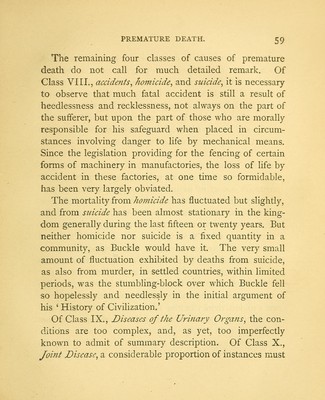
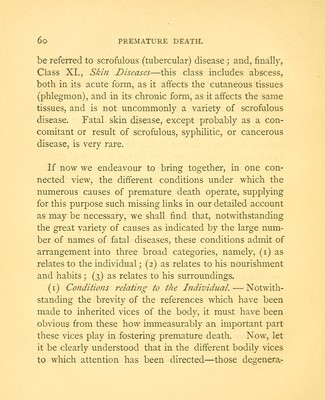
![to which nature directs all the accidental putridities which enter us. Whether they have been breathed or drunk or eaten, or sucked up into the blood from the surfaces of foul sores, or directly injected into blood- vessels by physiological experiments, there it is they settle and act. As wine ' gets into the head/ so these agents get into the bowels. There, as the universal result, they tend to produce diarrhoea—simple diarrhoea in the absence of specific infections; specific diarrhoea when the ferments of cholera and typhoid fever are in operation. And any such [irregular] distribution of diarrhceal disease as has just been noticed warrants a pre- sumption—indeed, so far as I know, a practical certainty —that in the districts which suffer high diarrheal death- rates, the population either breathes or drinks a large amount of putrefying animal refuse. * Diarrhceal disease (inclusive of common diarrhoea, simple cholera, and dysentery, but exclusive of malignant cholera and enteric fever) caused in England during the ten years 1861-70 not less than 215,823 deaths, and its local prevalence, measured by mortality, ranged from 57 (per 100,000 living) in the least unhealthy parts of the country to 195 (Yarmouth), 205 (Birmingham), and 299 (Liverpool). * ' Papers relating to the Sanitary State of the People of Eng- land,' p. xi.](https://iiif.wellcomecollection.org/image/b21072991_0064.jp2/full/800%2C/0/default.jpg)