Volume 1
The life of Florence Nightingale. Vol. II (1862-1910) / Sir Edward Cook.
- Cook, Sir Edward Tyas, 1857-1919.
- Date:
- 1913
Licence: In copyright
Credit: The life of Florence Nightingale. Vol. II (1862-1910) / Sir Edward Cook. Source: Wellcome Collection.
Provider: This material has been provided by London School of Hygiene & Tropical Medicine Library & Archives Service. The original may be consulted at London School of Hygiene & Tropical Medicine Library & Archives Service.
36/546 page 12
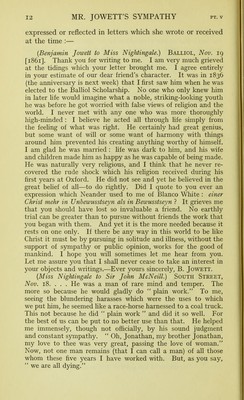
![expressed or reflected in letters which she wrote or received at the time :— [Benjamin Jowett to Miss Nightingale.) Balliol, Nov. 19 [1861]. Thank you for writing to me. I am very much grieved at the tidings which your letter brought me. I agree entirely in your estimate of our dear friend's character. It was in 1836 (the anniversary is next week) that I first saw him when he was elected to the Balliol Scholarship. No one who only knew him in later life would imagine what a noble, striking-looking youth he was before he got worried with false views of religion and the world. I never met with any one who was more thoroughly high-minded : I believe he acted all through life simply from the feeling of what was right. He certainly had great genius, but some want of will or some want of harmony with things around him prevented his creating anything worthy of himself. I am glad he was married : life was dark to him, and his wife and children made him as happy as he was capable of being made. He was naturally very religious, and I think that he never re- covered the rude shock which his religion received during his first years at Oxford. He did not see and yet he believed in the great belief of all—to do rightly. Did I quote to you ever an expression which Neander used to me of Blanco White : einer Christ mehr in Unbewusstseyn als in Bewusstseyn ? It grieves me that you should have lost so invaluable a friend. No earthly trial can be greater than to pursue without friends the work that you began with them. And yet it is the more needed because it rests on one only. If there be any way in this world to be like Christ it must be by pursuing in solitude and illness, without the support of sympathy or public opinion, works for the good of mankind. I hope you will sometimes let me hear from you. Let me assure you that I shall never cease to take an interest in your objects and writings.—Ever yours sincerely, B. Jowett. (Miss Nightingale to Sir John McNeill.) South Street, Nov. 18. . . . He was a man of rare mind and temper. The more so because he would gladly do plain work. To me, seeing the blundering harasses which were the uses to which we put him, he seemed like a race-horse harnessed to a coal truck. This not because he did plain work and did it so well. For the best of us can be put to no better use than that. He helped me immensely, though not officially, by his sound judgment and constant sympathy. Oh, Jonathan, my brother Jonathan, my love to thee was very great, passing the love of woman. Now, not one man remains (that I can call a man) of all those whom these five years I have worked with. But, as you say, we are all dying.](https://iiif.wellcomecollection.org/image/b21352173_002_0038.jp2/full/800%2C/0/default.jpg)