Volume 1
The life of Florence Nightingale. Vol. II (1862-1910) / Sir Edward Cook.
- Cook, Sir Edward Tyas, 1857-1919.
- Date:
- 1913
Licence: In copyright
Credit: The life of Florence Nightingale. Vol. II (1862-1910) / Sir Edward Cook. Source: Wellcome Collection.
Provider: This material has been provided by London School of Hygiene & Tropical Medicine Library & Archives Service. The original may be consulted at London School of Hygiene & Tropical Medicine Library & Archives Service.
40/546 page 16
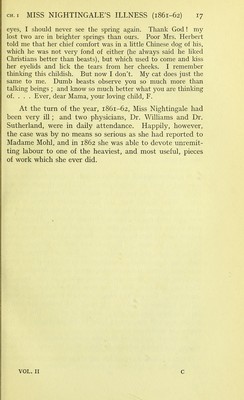
![I cannot understand how Mme Recamier could give advice and sympathy to such opposite people as, e.g. Mme Salvage and Chateaubriand. Neither can I understand how she could give support without recommending a distinct line of policy,— by merely keeping up the tone to a high one. It is as if I had said to Sidney Herbert, Be a statesman, be a statesman—instead of indicating to him a definite course of statesmanship to follow. Also I am sure I never could have given advice and sympathy to Gladstone and S. Herbert—men pursuing opposite lines of policy. Also I am sure I never could have been the friend and adviser of Sidney Herbert, of Alexander, and of others, by simply keeping up the tone of general conversation on promiscuous matters. We debated and settled measures together. That is the way we did it. Adieu, dear friend. ... I have had two consultations. They say that all this worry has brought on congestion of the spine which leads straight to paralysis. . . . (Miss Nightingale to her Mother.) 9 Chesterfield St., W., March 7 [1862]. Dearest Mother—So far from your letters being a bore, you are the only person who tells me any news. I have never been able to get over the morbid feeling at seeing my lost two's names in the paper, so that I see no paper. I did not know of the deaths you mention. . . . But they and others do not know how much they are spared by having no bitterness mingled with their grief. Such unspeakable bitterness has been connected with each one of my losses—far, far greater than the grief. . . . Sometimes I wonder that I should be so impatient for death. Had I only to stand and wait, I think it would be nothing, though the pain is so great that I wonder how anybody can dread an operation. ... I think what I have felt most (during my last three months of extreme weakness) is the not having one single person to give me one inspiring word or even one correct fact. I am glad to end a day which never can come back, gladder to end a night, gladdest to end a month. I have felt this much more in setting up (for the first time in my life) a fashionable old maid's house in a fashionable quarter (tho' grateful to Papa's liberality for enabling me to do so), because it is, as it were, deciding upon a new and independent course in my broken old age. . . . Thank you very much for the weekly box. I could not help sending the game, chicken, vegetables and flowers to King's College Hospital. I never see the spring without thinking of my Clough. He used to tell me how the leaves were coming out—always remembering that, without his brought a cessation of her constant activity in Miss Nightingale's service; but in later years aunt and niece took much counsel together in a resumed study of the religious subjects upon which they had formerly held intimate converse: see below, pp. 353, 387.](https://iiif.wellcomecollection.org/image/b21352173_002_0042.jp2/full/800%2C/0/default.jpg)