Volume 1
The life of Florence Nightingale. Vol. II (1862-1910) / Sir Edward Cook.
- Cook, Sir Edward Tyas, 1857-1919.
- Date:
- 1913
Licence: In copyright
Credit: The life of Florence Nightingale. Vol. II (1862-1910) / Sir Edward Cook. Source: Wellcome Collection.
Provider: This material has been provided by London School of Hygiene & Tropical Medicine Library & Archives Service. The original may be consulted at London School of Hygiene & Tropical Medicine Library & Archives Service.
56/546 page 32
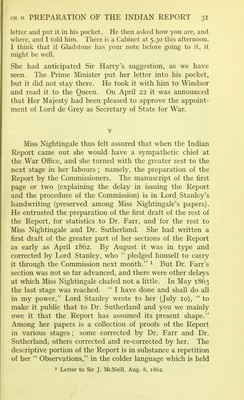
![MACHINERY FOR REFORM to add weight and dignity to such documents ; though here and there Miss Nightingale's touch may be felt. The magnitude of the evils which needed to be remedied is put in an arresting way. Besides deaths from natural causes [9 per 1000], 60 head per 1000 of our troops perish annually in India. It is at that expense that we have held dominion there for a century ; a company out of every regiment has been sacrificed every twenty months. These companies fade away in the prime of life ; leave few children ; and have to be replaced, at great cost, by successive shiploads of recruits. The cost of preventable sickness in the Indian army was calculated at £388,000 a year. The list of Recom- mendations with which the Report concludes may be described as a Sanitary Charter for the Army in India— a Charter which during many successive years was gradually put into force. Last of all came what Miss Nightingale considered the most vital point of all—namely, the suggestion of practical machinery by which, if the Government adopted it, the recommendations of the Commission might be carried out. At this crucial point, she had a very stiff fight. The machinery, as she had devised it, was to be twofold. First, there were to be Sanitary Commissions appointed for each Presidency in India. On this point, all the Commissioners seem to have been agreed ; but it was different with Miss Nightingale's second point. The reports which she had read and marked from the Indian stations filled her with a fear that if the whole of the initiative were left to India the work would in some cases be negligently or unintelligently done. There had not yet been in that country the same education of public opinion amongst the governing class in the science of sanitation that had been in progress in England. She deemed it essential that the machinery recommended by the Commission should in one way or another include provision to secure for India the experience already obtained in dealing with all kinds of sanitary questions in England. She had formulated her own plans to this end at an early stage of the Commission. What she first suggested was a Sanitary Department at the India Office, and this, as we shall hear in a later chapter (p. 153),](https://iiif.wellcomecollection.org/image/b21352173_002_0058.jp2/full/800%2C/0/default.jpg)