History of paganism in Caledonia : with an examination into the influence of Asiatic philosophy, and the gradual development of Christianity in Pictavia. / By Thomas A. Wise.
- Thomas Alexander Wise
- Date:
- 1884
Licence: Public Domain Mark
Credit: History of paganism in Caledonia : with an examination into the influence of Asiatic philosophy, and the gradual development of Christianity in Pictavia. / By Thomas A. Wise. Source: Wellcome Collection.
Provider: This material has been provided by Royal College of Physicians, London. The original may be consulted at Royal College of Physicians, London.
73/314 page 39
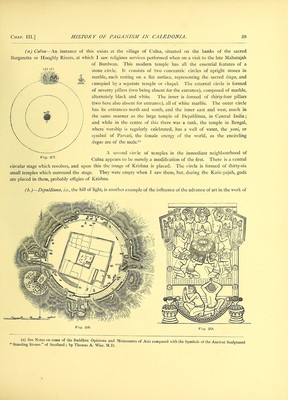
![(a) Bargaretta Culna—An or Hooghly («/) (»]) well instance of this exists at the village of Culna, situated on the banks of the sacred Rivers, at which I saw religious services performed when on a visit to the late Maharajah of Burdwan. This modern temple has all the essential features of a stone circle. It consists of two concentric circles of upright stones in marble, each resting on a flat surface, representing the sacred linga, and canopied by a separate temple or chapel. The external circle is formed of seventy pillars (two being absent for the entrance), composed of marble, alternately black and white. The inner is formed of thirty-four pillars (two here also absent for entrance), all of white marble. The outer circle has its entrances north and south, and the inner east and west, much in the same manner as the large temple of Depaldinna, in Central India; and while in the centre of this there was a tank, the temple in Bengal, where worship is regularly celebrated, has a well of water, the yoni, or symbol of Parvati, the female energy of the world, as the encircling lingas are of the male.'1' >r-— ' A second circle of temples in the immediate neighbourhood of Fig' 27' Culna appears to be merely a modification of the first. There is a central circular stage which revolves, and upon this the image of Krishna is placed. The circle is formed of thirty-six small temples which surround the stage. They were empty when I saw them, but, during the Katic-pajah, gods are placed in them, probably effigies of Krishna. (b.)—Depaldinna, i.e., the hill of light, is another example of the influence of the advance of art in the work of Fig. 28. Fig. 29. (i) See Notes on some of the Buddhist Opinions and Monuments of Asia compared with the Symbols of the Ancient Sculptured Standing Stones of Scotland ; by Thomas A. Wise. M.D.](https://iiif.wellcomecollection.org/image/b22652796_0073.jp2/full/800%2C/0/default.jpg)


 No text description is available for this image
 No text description is available for this image
 No text description is available for this image