On the animal alkaloids : the ptomaïnes, leucomaïnes, and extractives in their pathological relations ... / by Sir William Aitken.
- Date:
- 1887
Licence: Public Domain Mark
Credit: On the animal alkaloids : the ptomaïnes, leucomaïnes, and extractives in their pathological relations ... / by Sir William Aitken. Source: Wellcome Collection.
Provider: This material has been provided by the Royal College of Physicians of Edinburgh. The original may be consulted at the Royal College of Physicians of Edinburgh.
28/96 (page 14)
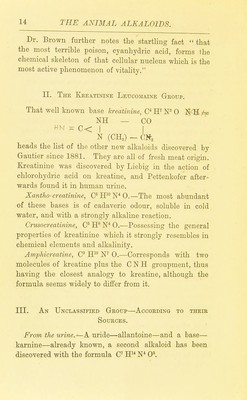
![Dr. Brown further notes the starthng fact that the most terrible poison, cyanhydric acid, forms Ihe chemical skeleton of that cellular nucleus which is the most active phenomenon of vitahty. II. The Kbeatinine Leucomaine Geoup. That well known base kreatinine, H'' 0 ]^ H == NH — CO HN = C< I I N (CH3) - heads the list of the other new alkaloids discovered by Gautier since 1881. They are all of fresh meat origin. Kreatinine was discovered by Liebig in the action of chlorohydric acid on kreatine, and Pettenkofer after- wards found it in human urine. Xantho-creatinine, C^HN*0.—The most abundant of these bases is of cadaveric odour, soluble in cold water, and with a strongly alkaline reaction. Crusocreatinine, IP W 0.—Possessing the general properties of kreatinine which it strongly resembles in chemical elements and alkahnity. Amphicreatine, C W 0.—Corresponds with two molecules of kreatine plus the C N H groupment, thus having the closest analogy to kreatine, although the formula seems widely to differ from it. III. An Unclassified Group—According to their Sources. From the urine.—A. uride—allantoine—and a base— karnine—already known, a second alkaloid has been discovered with the formula C^ H W 0*.](https://iiif.wellcomecollection.org/image/b21953193_0028.jp2/full/800%2C/0/default.jpg)