Licence: Public Domain Mark
Credit: British West Indian Conference on Quarantine, 1888. Source: Wellcome Collection.
Provider: This material has been provided by King’s College London. The original may be consulted at King’s College London.
167/254 page 159
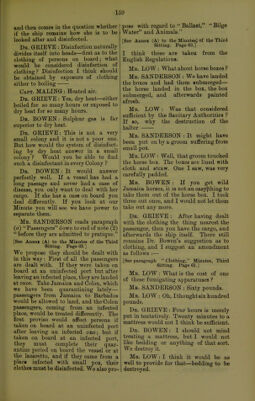
![and then comes in the question whether if the ship remains how she is to be looked after and disinfected. Db. grieve : Disinfection naturally divides itself into heads—first as to the clothing of persons on board; what would be considered disinfection of clothing ? Disinfection I think should be obtained by exposure of clothing either to boiling Capt. MALING : Heated air. Dr. GEIEVE : Yes, dry heat—either boiled for so many hours or exposed to dry heat for so many hours. Dr. bo WEN: Sulphur gas is far superior to dry heat. Dr. GRIEVE: This is not a very small colony and it is not a poor one. But how would the system of disinfect- ing by dry heat answer in a small colony ? Would you be able to find such a disinfectant in every Colony ? Dr. BOWEN: It would answer perfectly well. If a vessel has had a long passage and never had a case of disease, you only want to deal with her cargo. If she has a case on board you deal differently. If you look at our Minute you will see we have power to separate them. Mr. SANDERSON reads parapraph (a) Passengers down to end of note (2) before they are admitted to pratique. [See Annex (A) to the Minutes of the Third Sitting. Page 63.] We propose they should be dealt with in this way: First of all the passengers are dealt with. If they were taken on board at an uninfected port but after leaving an infected place, they are landed at once. Take Jamaica and Colon, which we have been quarantining lately— passengers from Jamaica to Barbados would be allowed to land, and the Colon passengers, coming from an infected place, would be treated differently. The first proviso would affect persons if taken on board at an uninfected port after leaving an infected one; but if taken on board at an infected port, they must complete their quar- antine period on board the vessel or at the lazaretto, and if they came from a place infected with small pox, their clothes must be disinfected. We also pro- pose with regard to Ballast, Bilge Water and Animals. [See Annex (A) to the Minutes] of the Third Sitting. Page 63.] I think these are taken from the English Regulations. Mr. low : What about horse boxes ? Mr. SANDERSON : We have landed the boxes and had them submerged— the horse landed in the box, the box submerged, and afterwards painted afresh. Mr. low : Was that considered sufficient by the Sanitary Authorities ? If so, why the destruction of the halter Mr. SANDERSON : It might have been put on by a groom suffering from small pox. Mr. low : Well, that groom touched the horse box. The boxes are lined with cloth and straw. One I saw, was very carefully padded. Mr. BOWEN : If you get wild Jamaica horses, it is not an easylthing to take them out of the horse box. I took three out once, and I would not let them take out any more. Dr. grieve : After having dealt with the clothing the thing nearest the passenger, then you have the cargo, and afterwards the ship itself. There still remains Dr. Bowen's suggestion as to clothing, and I suggest an amendment as follows :— [See paragraph Clothing, Minutes, Third Sitting. Page 61.] Mr. low : What is the cost of one of these fumigating apparatuses ? Mr. SANDERSON : Sixty pounds. Mr. low : Oh, I thought six hundred pounds. Dr. grieve : Four hours is merely put in tentatively. Twenty minutes to a mattress would not I think be sufficient. Dr. BOWEN: I should not mind treating a mattress, but I would not like bedding or anything of that sort. We destroy it. Mr. low : I think it would be as well to provide for that—bedding to be 1 destroyed.](https://iiif.wellcomecollection.org/image/b21297678_0167.jp2/full/800%2C/0/default.jpg)