Licence: Public Domain Mark
Credit: British West Indian Conference on Quarantine, 1888. Source: Wellcome Collection.
Provider: This material has been provided by King’s College London. The original may be consulted at King’s College London.
227/254 page 219
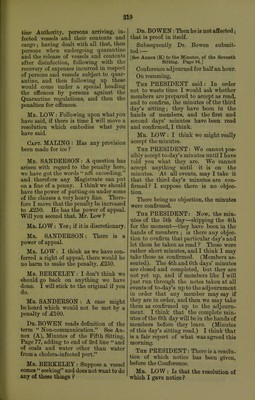
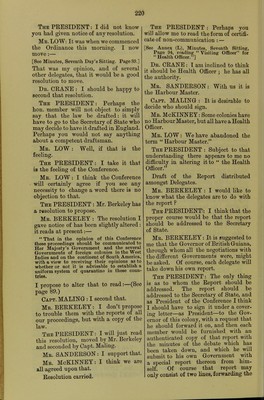
![tine Authority, persons arriving, in- fected vessels and tlieir contents and cargo ; having dealt with all that, then persons when undergoing quarantine and the release of vessels and contents after disinfection, following with the recovery of expenses incurred in respect of persons and vessels subject to quar- antine, and then following up these would come under a special heading the offences by persons against the Quarantine regulations, and then the penalties for offences. Mk. LOW: Following upon what you have said, if there is time I will move a resolution which embodies what you have said. Capt. MALING : Has any provision been made for ice ? Mr. SANDEESON : A question has arisen with regard to the penalty here, we have got the words 7i6t exceeding, and therefore any Magistrate can put on a fine of a penny. I think we should have the power of putting on under some of the clauses a very heavy fine. There- fore I move that the penalty be increased to o£250. He has the power of appeal. Will you second that, Mr. Low ? Me. low : Yes; if it is discretionary. Mr. SANDERSON: There is a power of appeal. Mr. low : I think as we have con- ferred a right of appeal, there would be no harm to make the penalty, d8250. Mr. BERKELEY: I don't think we should go back on anything we have done. I will stick to the original if you do. Mr. SANDERSON : A case might be heard which would not be met by a penalty of dglOO. Dr. BOWEN reads definition of the term Non-communication. See An- nex (A), Minutes of the Fifth Sitting, Page 77, adding to end of 3rd line and of coals and water other than water from a cholera-infected port. Mr. BERKELEY : Suppose a vessel comes seeking and does not want to do any of these things ? Dr. BOWEN: Then he is not affected; that is proof in itself. Subsequently Dr. Bowen submit- ted :— [See Annex (K) to the Minutes, of the Seventh Sitting. Page 94.] Conference adjourned for haK an hour. On resuming. The PRESIDENT said: In order not to waste time I would ask whether members are prepared to accept as read, and to confirm, the minutes of the third day's sitting; they have been in the hands of members, and the first and second days' minutes have been read and confirmed, I think. Mr. low : I think we might really accept the minutes. The PRESIDENT: We cannot pos- sibly accept to-day's minates until I have told you what they are. We cannot accept anything until it is on the minutes. At all events, may I take it that the third day's minutes are con- firmed? I suppose there is no objec- tion. There being no objection, the minutes were confirmed. The PRESIDENT: Now, the min- utes of the 5th day—skipping the 4th for the moment—they have been in the hands of members ; is there any objec- tion to confirm that particular day's and let them be taken as read ? These were rather short minutes, and I think I may take these as confirmed. (Members as- sented). The 4th and 6th days' minutes are closed and completed, but they are not yet up, and if memljers like I will just run through the notes taken at all events of to-day's up to the adjournment in order that any member may say if they are in order, and then we may take them as confirmed up to the adjourn- ment. I think that the complete min- utes of the 6th day will be in the hands of members before they leave. (Minutes of this day's sitting read.) I think that is a fair report of what was agreed this morning. The president : There is a resolu- tion of which notice has been given, before the Conference. Mr. low : Is that the resolution of which I gave notice ?](https://iiif.wellcomecollection.org/image/b21297678_0227.jp2/full/800%2C/0/default.jpg)