Licence: Public Domain Mark
Credit: Surgery of the lung / by C. Garrè and H. Quincke. Source: Wellcome Collection.
Provider: This material has been provided by the Francis A. Countway Library of Medicine, through the Medical Heritage Library. The original may be consulted at the Francis A. Countway Library of Medicine, Harvard Medical School.
46/292
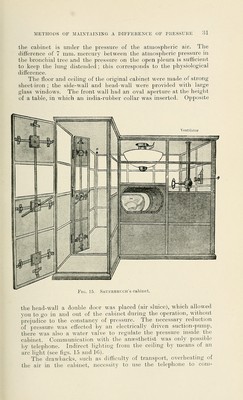
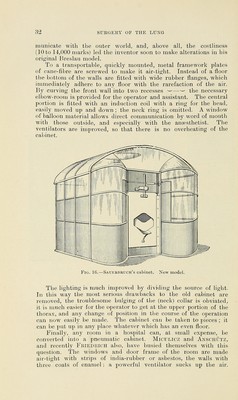
![which they constructed, and which was also of use to Tufpier in an operation on the lung, consisted of a laryngeal tube in connection with a pair of bellows with a water valve in between to regulate the pressure. Finally, Doyen (1897) recommended another kind of bellows, which allowed alternately of insufflation and respiration. Whereas, in Europe, not much was expected from such appara- tus for the surgery of the lung, and in any case they were not per- fected for practical application in America, the idea was more favourably received among the ranks of American surgeons. Northrup replaced, in 1896, an apparatus used by Fell in a case of opium poisoning by the improved O'Dwyer ] tube; in this way the whole apparatus became certainly very manageable, but still not practically useful in the primitive state. E. Matas, in 190'2, replaced the bellows by a forcing-pump worked by a cylinder, which drives out the air breathed and draws it in again. The adjustment of the cock for inspiration and ex- piration works automatically. Further essential improvements are the addition of an air filter, a mercury manometer and a device for the introduction of ether and chloroform to produce anaesthesia. In spite of the certainly important aid afforded by these in- struments, no use worth mentioning has been made of them in the practical surgery of the lung. Sauerbruch was the first to succeed in making the method of maintaining a difference of pressure available in a practical form, physiologically without exception, by the construction of a pneu- matic cabinet. Incited thereto by Mikulicz, in the year 1904 he entered upon the study of the method of maintaining difference of pressure ; as is well known, he abandoned the method of increas- ing the pressure, as it proved less reliable in experiments. He then improved the method of reducing the pressure in the surgery of the thorax applied to human beings with such genius that he paved the way to the greatest progress in the domain of the surgery of the thorax which has been known of late years. His thorough and purposeful studies were the starting point and inspiration of a large number of very cleverly thought-out apparatus for operations in the free pleural cavity by the application of the principle both of increased and diminished pressure. These apparatus have become useful, nay, indispensable, not only for operations on the pleura and lung, but also for the surgery of the heart and the great intrathoracic vessels, and, above all, in the surgery of the oesophagus. The Cabinet for Reducing the Pressure. Sauerbruch started with the following idea : To produce, by means of a large pneumatic cabinet over the body of the patient, a negative pressure of about 7 mm. mercury, and to maintain this throughout the duration of the operation, whilst the head outside 1 Illustrations of the apparatus of Fell and O'Dwyer and of Matas are given in the first edition of this book.](https://iiif.wellcomecollection.org/image/b21173813_0046.jp2/full/800%2C/0/default.jpg)