Licence: Public Domain Mark
Credit: Surgery. Source: Wellcome Collection.
Provider: This material has been provided by the Augustus C. Long Health Sciences Library at Columbia University and Columbia University Libraries/Information Services, through the Medical Heritage Library. The original may be consulted at the the Augustus C. Long Health Sciences Library at Columbia University and Columbia University.
54/1208 page 28
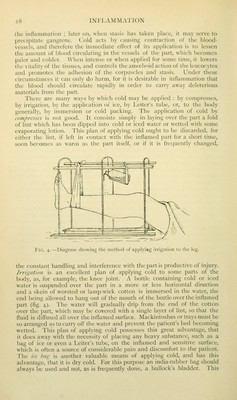
![the inllanimalion ; later on, when stasis lias taken ])la(e, it may serve to precipitate gangrene. Cold acts by causing contraction of the blood- vessels, and therefore the immediate effect of its application is to lessen the amount of blood circulating in the vessels of the part, which becomes paler and colder. When intense or when applied for some time, it lowers the vitality of the tissues, and controls the amoeboid action of the leucocytes and promotes the adhesion of the corpuscles and stasis. Under these circumstances it can only do harm, for it is desirable in inflammation that the blood should circulate rapidly in order to carry away deleterious materials from the part. There are many ways by which cold may be applied : by compresses, by irrigation, by the application of ice, by Leiter's tube, or, to the body generally, by immersion or cold packing. The application of cold by compresses is not good. It consists simply in laying over the part a fold of lint which has been dipped into cold or iced water or wetted with some evaporating lotion. This plan of applying cold ought to be discarded, for either the lint, if left in contact with the inflamed part for a short time, soon becomes as warm as the part itself, or if it is frequently changed, Fig. 4.—Diagram shcnving the niu-lhod of applyiug irrigalicjn to the leg. the constant handling and interference with the part is productive of injury. Irrigation is an excellent plan of applying cold to some parts of the body, as, for example, the knee joint. A bottle containing cold or iced water is suspended over the part in a more or less horizontal direction and a skein of worsted or lamp-wick cotton is immersed in the water, the end being allowed to hang out of the mouth of the bottle over the inflamed part (fig. 4;. The water will gradually drip from the end of the cotton over the part, which may be covered with a single layer of lint, so that the fluid is diffused all over the inflamed surface. Mackintoshes or trays must be so arranged as to carry off the water and prevent the patient's bed becoming wetted. This plan of applying cold possesses this great advantage, that it does away with the necessity of placing any heavy substance, such as a bag of ice or even a Leiter's tul)e, on the inflamed and sensitive surface, which is often a source of considerable pain and discomfort to the patient. The ice bag is another valuable means of applying cold, and has this advantage, that it is dry cold. For this purpose an india-rubber bag should always be used and not, as is fre(iuently done, a bullock's bladder. This](https://iiif.wellcomecollection.org/image/b21210846_0054.jp2/full/800%2C/0/default.jpg)