Japanese wood-cutting and wood-cut printing / by T. Tokuno ; edited by S.R. Koehler.
- Tokuno, T.
- Date:
- 1894
Licence: Public Domain Mark
Credit: Japanese wood-cutting and wood-cut printing / by T. Tokuno ; edited by S.R. Koehler. Source: Wellcome Collection.
31/56 page 231
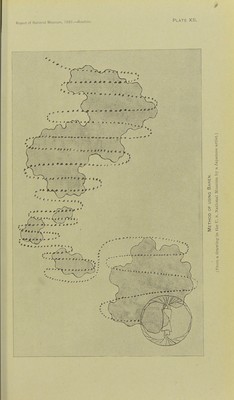
![reason why it is made so hard, besides making the tilling of twisted cord, is to prevent its bending during use. Moreover, if it were not so hard and rigid, the full stretching of the bamboo sheath would be im- possible. The ribbed surface of the bamboo serves not only to get a sharper impression, by limiting the contact to the ribs, but it also pre- vents the adhesion of the wet paper to the baren, which would occur, to the spoiling of the paper, if the covering were smooth. The con- tacting surface should be applied only to those parts of the plank which have been left standing in relief. If this precaution is neglected, there is the possibility of smearing from the depressed parts of the block. The direction in the movement of the <'baren should be zigzag, as shown ou Plate xi, but if a very small and isolated part of the design is to be printed, it is better to give a lighter rub with the edge of the in- strument. On Plate xii the dotted line shows the direction of the baren, while the sobd curved lines mark the outlines of the design. The rib of the bamboo sheath should be kept as nearly as possible at a riglit angle to the direction of the baren. Smearing from the depressions of the hlocli. As the depressions of the cut planks—that is to say, those parts which have been cut away be- tween the lines and masses of the design—are rather shallow, and at the same time in many cases quite extensive, it would seem almost im- possible to prevent the sinking of the sheet into the depressions and taking the color in these places, more especially when the method of applying the printing color with a brush is considered, whicb makes it impossible to keep the depressions clean. Experienced printers, never- theless, work without fear of smearing, and no special precautious are used to guard against it. Registering. As each color requires a separate cut, each plank must have certain fixed marks [registering marks], so that all the sheets may be laid down in exactly the same position, to insure the fitting of each color upon the others. No mechanical means Avhatever are used, either in placing the sheet, or for holding it in position after ib has been jjlaced. The Japanese printer, in these matters as in all others, depends simply upon exjjerieuce. The manner of placing the sheet on the block is shown on Plate xiii. The same figure shows also the registering marks on the block or plank, which consist of a rectangular notch | at the right, and a straight notch at the left. General remar'ks about printing. The printing may differ in quality, but the method employed is always about the same. The j^rinting of a picture like Xandina domestica [which is an imitation of a water- color painting without outlines] requires, of course, greater skill than the printing of Yinaka genji [which is a drawing in outlhies, with color washes]. The aim in this case is to produce impressions which an inexperienced eye can hardly distinguish from the original. But there is no special way of treating either class of prints. The difference between the best and the less good is due entirely to the skill of the](https://iiif.wellcomecollection.org/image/b21782234_0031.jp2/full/800%2C/0/default.jpg)