Insanity in its relations to crime : atext and a commentary / by William A. Hammond.
- William Alexander Hammond
- Date:
- 1873
Licence: Public Domain Mark
Credit: Insanity in its relations to crime : atext and a commentary / by William A. Hammond. Source: Wellcome Collection.
Provider: This material has been provided by the Francis A. Countway Library of Medicine, through the Medical Heritage Library. The original may be consulted at the Francis A. Countway Library of Medicine, Harvard Medical School.
54/112 page 48
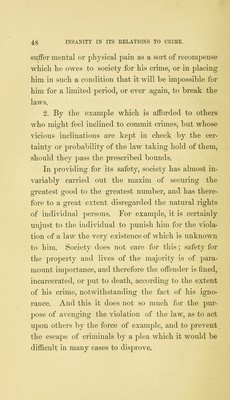
![suffer mental or physical pain as a sort of recompense wMcL. lie owes to society for his crime, or in placing him in such a condition that it will be impossible for him for a limited period, or ever again, to break the laws. 2. By the example which is afforded to others who might feel inclined to commit crimes, but whose vicious inclinations are kept in check by the cer- tainty or probability of the law taking hold of them, should they pass the prescribed bounds. In providing for its safety, society has almost in- variably carried out the maxim of securing the greatest good to the greatest number, and has there- fore to a great extent disregarded the natural rights of individual persons. For exam]3le, it is certainly unjust to the individual to punish him for the viola- tion of a law the very existence of which is unknown to him. Society does not care for this; safety for the property and lives of the majority is of para- mount importance, and therefore the offender is fined, incarcerated, or put to death, according to the extent of his crime, notwithstanding the fact of his igno- rance. And this it does not so much for the pur- pose of avenging the violation of the law, as to act upon others by the force of examjDle, and to prevent the escape of criminals by a plea which it would be difficult in many cases to disprove.](https://iiif.wellcomecollection.org/image/b21056833_0054.jp2/full/800%2C/0/default.jpg)