Stem cells research, 2005 : hearing before a Subcommittee of the Committee on Appropriations, United States Senate, One Hundred Ninth Congress, first session, special hearing, October 19, 2005, Washington, DC.
- United States. Congress. Senate. Committee on Appropriations. Subcommittee on Departments of Labor, Health and Human Services, Education, and Related Agencies
- Date:
- 2006
Licence: Public Domain Mark
Credit: Stem cells research, 2005 : hearing before a Subcommittee of the Committee on Appropriations, United States Senate, One Hundred Ninth Congress, first session, special hearing, October 19, 2005, Washington, DC. Source: Wellcome Collection.
11/30 page 7
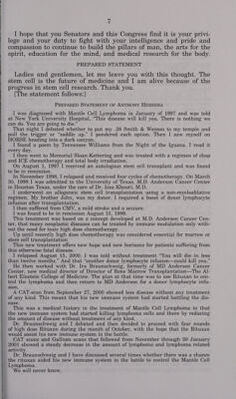
![I hope that you Senators and this Congress find it is your privi- lege and your duty to fight with your intelligence and pride and compassion to continue to build the pillars of man, the arts for the spirit, education for the mind, and medical research for the body. PREPARED STATEMENT Ladies and gentlemen, let me leave you with this thought. The stem cell is the future of medicine and I am alive because of the progress in stem cell research. Thank you. [The statement follows:] PREPARED STATEMENT OF ANTHONY HERRERA I was diagnosed with Mantle Cell Lymphoma in January of 1997 and was told at New York University Hospital, “This disease will kill you. There is nothing we can do. You are going to die.” That night I debated whether to put my .38 Smith & Wesson to my temple and pull the trigger or “saddle up.” I pondered each option. Then I saw myself on HORSE heading into a dark canyon. I found a poem by Tennessee Williams from the Night of the Iguana. I read it every day. I then went to Memorial Sloan-Kettering and was treated with a regimen of chop and ICE chemotherapy and total body irradiation. On August 1, 1997 I received an autologous stem cell transplant and was found to be in remission. In November 1998, I relapsed and received four cycles of chemotherapy. On March 30, 1999 I was admitted to the University of Texas, M.D. Anderson Cancer Center in Houston Texas, under the care of Dr. Issa Khouri, M.D. I underwent an allogeneic stem cell transplantation using a non-myeloablative regimen. My brother John, was my donor. I required a boost of donor lymphocyte infusion after transplantation. I then suffered from CMV, a mild stroke and a seizure. I was found to be in remission August 15, 1999. This treatment was based on a concept developed at M.D. Anderson Cancer Cen- ter, that many neoplastic diseases can be treated by immune modulation only with- out the need for toxic high dose chemotherapy. Up until recently high dose chemotherapy was considered essential for marrow or stem cell transplantation. This new treatment offers new hope and new horizons for patients suffering from this otherwise fatal disease. I relapsed August 15, 2000. I was told without treatment “You will die in less than twelve months.” And that “another donor lymphocyte infusion—could kill you.” He then worked with Dr. Ira Braunschweig, formerly of MD Anderson Cancer Center, now medical director of Director of Bone Marrow Transplantation—The Al- bert Einstein College of Medicine. The plan at that time was to use Rituxan to con- trol the lymphoma and then return to MD Anderson for a donor lymphocyte infu- sion. A CAT-scan from September 27, 2000 showed less disease without any treatment of any kind. This meant that his new immune system had started battling the dis- ease. This was a medical history in the treatment of Mantle Cell Lymphoma in that the new immune system had started killing lymphoma cells and there by reducing the amount of disease without treatment of any kind. Dr. Braunschweig and I debated and then decided to proceed with four rounds of high dose Rituxan during the month of October, with the hope that the Rituxan would assist his new immune system in the battle. CAT scans and Gallium scans that followed from November through 30 January 2001 showed a steady decrease in the amount of lymphoma and lymphoma related activity. Dr. Braunschweig and I have discussed several times whether there was a chance the rituxan aided his new immune system in the battle to control the Mantle Cell Lymphoma. We will never know.](https://iiif.wellcomecollection.org/image/b32229392_0011.jp2/full/800%2C/0/default.jpg)