Stem cells research, 2005 : hearing before a Subcommittee of the Committee on Appropriations, United States Senate, One Hundred Ninth Congress, first session, special hearing, October 19, 2005, Washington, DC.
- United States. Congress. Senate. Committee on Appropriations. Subcommittee on Departments of Labor, Health and Human Services, Education, and Related Agencies
- Date:
- 2006
Licence: Public Domain Mark
Credit: Stem cells research, 2005 : hearing before a Subcommittee of the Committee on Appropriations, United States Senate, One Hundred Ninth Congress, first session, special hearing, October 19, 2005, Washington, DC. Source: Wellcome Collection.
20/30 page 16
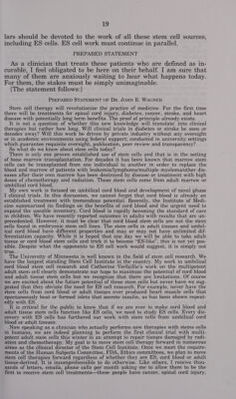
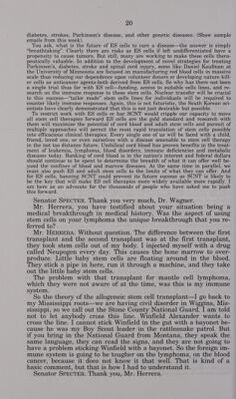
![of kids with osteopetrosis. The use of SCNT, in which embryonic stem cells contain the patient’s own DNA, if successful, would markedly increase the cure rate of this disease. PREPARED STATEMENT Mr. Chairman, because of my familiarity with osteopetrosis, I am frequently contacted by parents with afflicted children. I have to tell them that the chances of curing your child is no more than 10 percent. I want to tell them it is greater than 90 percent. SCNT, if we pursue it, may get us there. Thank you. [The statement follows:] PREPARED STATEMENT OF DR. STEVEN TEITELBAUM Thank you Mr. Chairman. My name is Steven Teitelbaum. I’m the Wilma and Roswell Messing Professor of Pathology and Immunology at Washington University ary of Medicine and I thank the committee for the honor of speaking to you today. Mr. Chairman, I’ve been a physician-scientist for more than 30 years. I’ve au- thored in excess of 300 scientific papers and I’m here to tell you that, in my esti- mation, we are facing a unique opportunity in the form of embryonic stem cell re- search, to potentially alleviate the misery of our fellow Americans with a number of presently incurable diseases. But to get there, we must do the science. Opponents of human embryonic stem cell research often articulate their position as a contest between adult an embryonic stem cells. Mr. Chairman, this is not a contest between various types of stem cells. It is a contest between us as a society and disease. We should be moving forward on all fronts, adult, embryonic and um- bilical cord stem cells, to win the battle. The tool is not important. What counts is curing our neighbors. That said, because of their flexibility, embryonic stem cells hold more promise to ameliorate presently incurable diseases than any other approach. I stress the word “promise” because we are not there yet and it is my belief that it will be some time before we: are positioned to safely use these cells for therapy. But if scientists are prevented from exploring the biology of human embryonic stem cells, we will never get there. Mr. Chairman, as you know, human embryonic stem cells can presently be ob- tained from two sources, namely the spare products of in vitro fertilization, which ultimately would be destroyed, and by somatic cell nuclear transfer, also known as SCNT or therapeutic cloning. Although both approaches hold enormous therapeutic potential, ’m particularly taken with the promise of SCNT because it may alleviate the major complication of tissue and cell transplantation, namely rejection and its attendant life threatening consequences. Mr. Chairman, I’m a bone biologist and physician and as such I see many patients who have received organ and cell transplants. These patients typically develop se- vere osteoporosis and often have many fractures because of the harsh medications they must take to prevent rejection of their transplant. It is my hope that embryonic stem cells, generated by SCNT, which contain the transplant recipient’s own DNA, will reduce the necessity for these devastating anti-rejection drugs. But Mr. Chairman, my hopes for SCNT are more personal and hearken back more than 20 years when I was a young assistant professor. At that time I became inter- ested in a genetic disease of the skeleton known as osteopetrosis or marble bone dis- ease and I want to tell you a story about an afflicted child who profoundly impacted my life. Osteopetrosis is a disease in which kids make too much bone. Consequently, their skulls become very thick and compress their brains and nerves, such as those leading to the eye. Bone also overgrows the bone marrow preventing formation of blood cells. Until the story I’m about to tell you, all kids with the malignant form of osteopetrosis developed fatal neurological complications, including blindness, and infections due to bone marrow suppression. These children invariably died in the first decade, most before the age of five. In the early 80s, our team thought we had identified the abnormal cell causing osteopetrosis and concluded it resided in the bone marrow. We reasoned, therefore, that if we gave an osteopetrotic infant a bone marrow transplant, which contains adult stem cells, we might cure the disease. We realized the enormous risk of rejec- tion so we waited until we had a perfect immunological match between the donor](https://iiif.wellcomecollection.org/image/b32229392_0020.jp2/full/800%2C/0/default.jpg)