Stem cells research, 2005 : hearing before a Subcommittee of the Committee on Appropriations, United States Senate, One Hundred Ninth Congress, first session, special hearing, October 19, 2005, Washington, DC.
- United States. Congress. Senate. Committee on Appropriations. Subcommittee on Departments of Labor, Health and Human Services, Education, and Related Agencies
- Date:
- 2006
Licence: Public Domain Mark
Credit: Stem cells research, 2005 : hearing before a Subcommittee of the Committee on Appropriations, United States Senate, One Hundred Ninth Congress, first session, special hearing, October 19, 2005, Washington, DC. Source: Wellcome Collection.
23/30 page 19
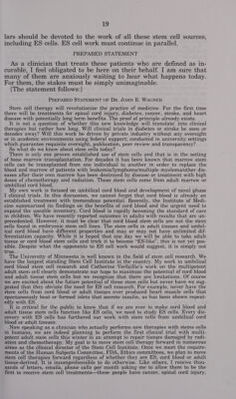
![lars should be devoted to the work of all these stem cell sources, including ES cells. ES cell work must continue in parallel. PREPARED STATEMENT As a clinician that treats these patients who are defined as in- curable, I feel obligated to be here on their behalf. I am sure that many of them are anxiously waiting to hear what happens today. For them, the stakes must be simply unimaginable. [The statement follows:] PREPARED STATEMENT OF DR. JOHN E. WAGNER Stem cell therapy will revolutionize the practice of medicine. For the first time there will be treatments for spinal cord injury, diabetes, cancer, stroke, and heart disease with potentially long term benefits. The proof of principle already exists. It is not a question of whether this new knowledge will translate’ into clinical therapies but rather how long. Will clinical trials in diabetes or stroke be soon or decades away? Will this work be driven by private industry without any oversight or in academic environments using federal support; conducted in university settings which guarantee requisite oversight, publication, peer review and transparency? So what do we know about stem cells today? There is only one proven established use of stem cells and that is in the setting of bone marrow transplantation. For decades it has been known that marrow stem cells can be transplanted from one individual to another in order to replace the blood and marrow of patients with leukemia/lymphoma/multiple myeloma/other dis- eases after their own marrow has been destroyed by disease or treatment with high doses of chemotherapy and radiation. These stem cells come from adult marrow or umbilical cord blood. My own work is focused on umbilical cord blood and development of novel phase I clinical trials. In this discussion, we cannot forget that cord blood is already an established treatment with tremendous potential. Recently, the Institute of Medi- cine summarized its findings on the benefits of cord blood and the urgent need to expand the useable inventory. Cord blood is rapidly becoming the standard of care in children. We have recently reported outcomes in adults with results that are un- precedented. However, it must be clear that cord blood stem cells are not the stem cells found in embryonic stem cell lines. The stem cells in adult tissues and umbil- ical cord blood have different properties and may or may not have unlimited dif- ferentiation capacity. While it is hoped that one day we will be able to take adult tissue or cord blood stem cells and trick it to become “ES-like”, this is not yet pos- sible. Despite what the opponents to ES cell work would suggest, it is simply not true. The University of Minnesota is well known in the field of stem cell research. We have the longest standing Stem Cell Institute in the country. My work in umbilical cord blood stem cell research and Catherine Verfaillie’s work on the multipotent adult stem cell clearly demonstrate our hope to maximize the potential of cord blood and adult tissue stem cells but we recognize that there are limitations. Of course we are excited about the future potential of these stem cells but never have we sug- gested that they obviate the need for ES cell research. For example, never have the stem cells from cord blood or adult tissues ever produced heart muscle cells that spontaneously beat or formed islets that secrete insulin, as has been shown repeat- edly with ES. It is critical for the public to know that if we are ever to make cord blood and adult tissue stem cells function like ES cells, we need to study ES cells. Every dis- covery with ES cells has furthered our work with stem cells from umbilical cord blood or adult tissues. Now speaking as a clinician who actually performs new therapies with stems cells in humans, we are indeed planning to perform the first clinical trial with multi- potent adult stem cells this winter in an attempt to repair tissues damaged by radi- ation and chemotherapy. My goal is to move stem cell therapy forward in numerous areas as the clinical director of the Stem Cell Institute. Once we meet the require- ments of the Human Subjects Committee, FDA, Ethics committees, we plan to move stem cell therapies forward regardless of whether they are ES, cord blood or adult tissue-derived. It is incomprehensible to do otherwise. Like others, I receive thou- sands of letters, emails, phone calls per month asking me to allow them to be the first to receive stem cell treatments—these people have cancer, spinal cord injury,](https://iiif.wellcomecollection.org/image/b32229392_0023.jp2/full/800%2C/0/default.jpg)