Stem cells research, 2005 : hearing before a Subcommittee of the Committee on Appropriations, United States Senate, One Hundred Ninth Congress, first session, special hearing, October 19, 2005, Washington, DC.
- United States. Congress. Senate. Committee on Appropriations. Subcommittee on Departments of Labor, Health and Human Services, Education, and Related Agencies
- Date:
- 2006
Licence: Public Domain Mark
Credit: Stem cells research, 2005 : hearing before a Subcommittee of the Committee on Appropriations, United States Senate, One Hundred Ninth Congress, first session, special hearing, October 19, 2005, Washington, DC. Source: Wellcome Collection.
29/30 page 25
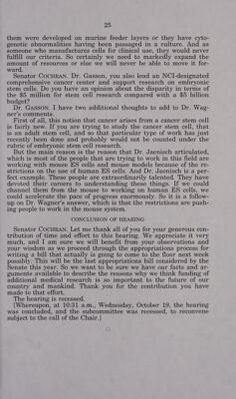
![them were developed on murine feeder layers or they have cyto- genetic abnormalities having been passaged in a culture. And as someone who manufactures cells for clinical use, they would never fulfill our criteria. So certainly we need to markedly expand the amount of resources or else we will never be able to move it for- ward. Senator COCHRAN. Dr. Gasson, you also lead an NCI-designated comprehensive cancer center and support research on embryonic stem cells. Do you have an opinion about the disparity in terms of the $5 million for stem cell research compared with a $5 billion budget? Dr. GASSON. I have two additional thoughts to add to Dr. Wag- ner’s comments. First of all, this notion that cancer arises from a cancer stem cell is fairly new. If you are trying to study the cancer stem cell, that is an adult stem cell, and so that particular type of work has just recently been done and probably would not be counted under the rubric of embryonic stem cell research. But the main reason is the reason that Dr. Jaenisch articulated, which is most of the people that are trying to work in this field are working with mouse ES cells and mouse models because of the re- strictions on the use of human ES cells. And Dr. Jaenisch is a per- fect example. These people are extraordinarily talented. They have devoted their careers to understanding these things. If we could channel them from the mouse to working on human ES cells, we could accelerate the pace of progress enormously. So it is a follow- up on Dr. Wagner’s answer, which is that the restrictions are push- ing people to work in the mouse system. CONCLUSION OF HEARING Senator COCHRAN. Let me thank all of you for your generous con- tribution of time and effort to this hearing. We appreciate it very much, and I am sure we will benefit from your observations and your wisdom as we proceed through the appropriations process for writing a bill that actually is going to come to the floor next week possibly. This will be the last appropriations bill considered by the Senate this year. So we want to be sure we have our facts and ar- guments available to describe the reasons why we think funding of additional medical research is so important to the future of our country and mankind. Thank you for the contribution you have made to that effort. The hearing is recessed. [Whereupon, at 10:31 a.m., Wednesday, October 19, the hearing was concluded, and the subcommittee was recessed, to reconvene subject to the call of the Chair. ] O](https://iiif.wellcomecollection.org/image/b32229392_0029.jp2/full/800%2C/0/default.jpg)